
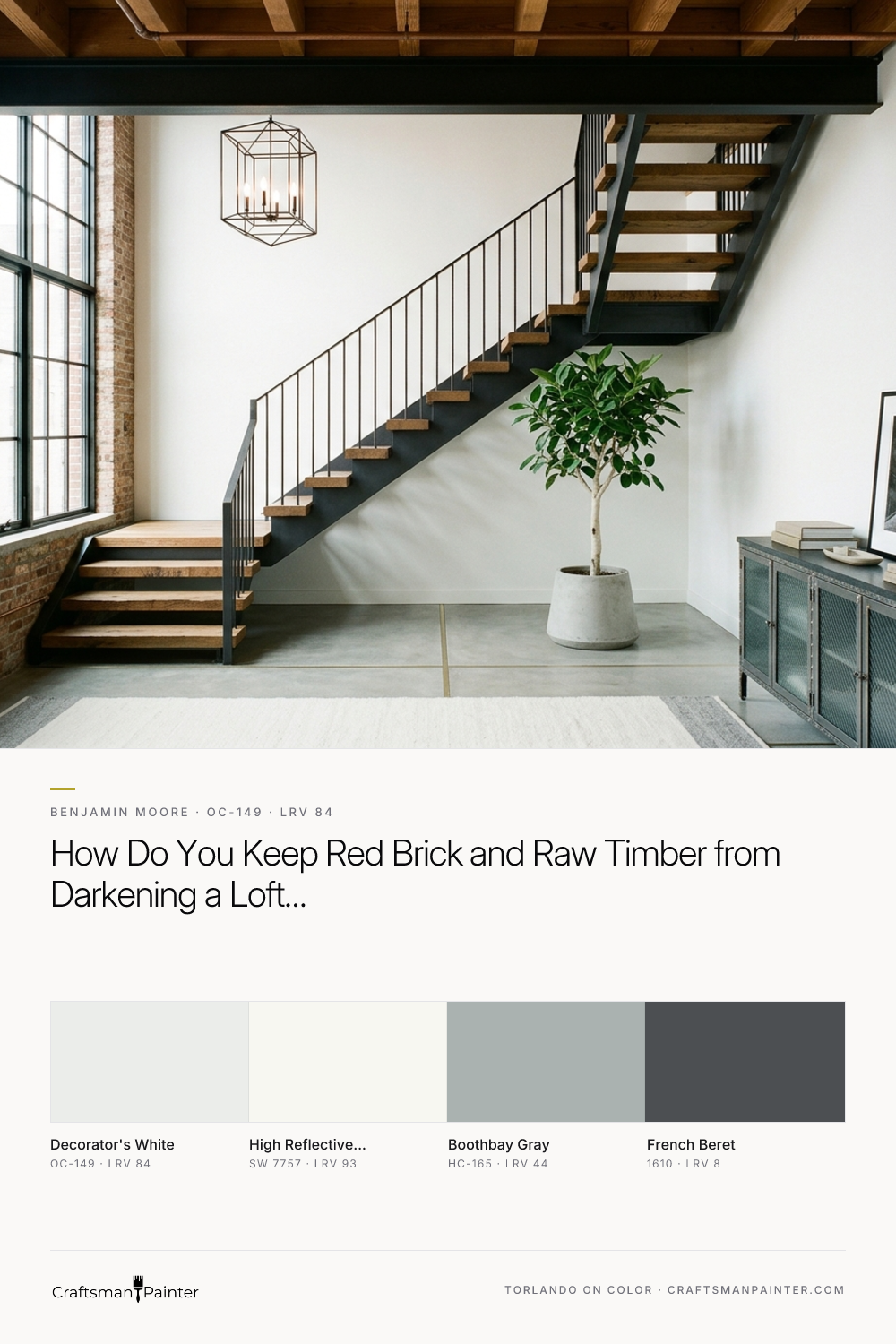


To keep a tall foyer and architectural stairwell feeling open, the surrounding plaster and drywall need a cool, disciplined counterpoint. Benjamin Moore Decorator's White (OC-149) resolves this tension through a crisp modern white profile backed by a distinct cool gray-blue undertone. Instead of competing with the fiery oranges and rusts of aged brick or the honeyed grain of rough-sawn timber, its cool mineral backbone gives those warmer materials breathing room.
In the visualization below of an urban industrial loft foyer and architectural stairwell, you can see how Decorator's White sets the chromatic tone for the entire residence. With a Light Reflectance Value (LRV) of 84, it has enough reflective power to bounce daylight deep into a double-height entry volume, while its cool gray-blue foundation prevents the tall drywall expanses from feeling chalky or glaring against the raw structural concrete pillars and steel I-beams. For the crisp linear baseboards and structural casing, we paired the walls with Sherwin-Williams High Reflective White (SW 7757), which provides a clean, pure edge without breaking the modern sensibility of the entry.
How Factory Grid Daylight and Late-Autumn Skies Shape the Undertone
Real-paint peel-and-stick samples ship via Samplize. Craftsman Painter may earn a small commission on sample orders at no extra cost to you.
Because an entryway stairwell connects multiple floors, its walls catch shifting bands of natural and artificial light throughout the day. Here in Brownsburg and across central Indiana, the transition into November and December brings low-angle late-autumn and early-winter afternoon light. That seasonal light carries a silvery, oblique clarity during the middle of the day before dropping early into the evening hours.
When that soft, even daylight filters through multi-pane dark iron factory grid windows with metal crank handles, the cool gray-blue undertone of Decorator's White steps forward just enough to feel architectural and deliberate. An LRV of 84 sits in a very practical sweet spot for high-volume loft spaces: it reflects the overwhelming majority of available window light across the drywall, yet holds onto a faint slate-gray shadow in the corners where the drywall meets exposed red brick masonry or steel I-beams.
Notice in this medium-wide design study around the factory window wall how Sherwin-Williams High Reflective White on the surrounding window stool and trim casing clarifies the subtle cool tint of Decorator's White. By placing a cleaner, higher-reflectance white right next to OC-149, the eye immediately reads Decorator's White as a purposeful, softly shaded architectural tone rather than a plain builder white. If your home leans toward warmer, sun-baked limestone and traditional millwork where a creamier backdrop makes more sense, compare this cool approach with our notes in The Craftsman’s Review of Natural Linen (SW 9109): The Timeless, Effortless Neutral. In an industrial loft filled with dark iron grids and copper runs, however, Decorator's White provides the exact cool geometry the room calls for.

Bridging the Stairwell into the Loft Dining Space with Boothbay Gray
A high-impact foyer and stairwell should never feel cut off from the living and dining areas it feeds. In an open or semi-open loft floor plan, your eye travels straight past the entry concrete pillars into the adjoining gathering spaces. As we move into the pre-holiday dining and hosting season in November and December, those sightlines matter even more because guests experience the entryway and the dining room as one continuous visual sequence.
To transition from the bright vertical volume of the stairwell into an intimate adjoining dining area, we brought in Benjamin Moore Boothbay Gray (HC-165) as a bridge shade. Boothbay Gray shares the same cool, coastal-mineral DNA as Decorator's White, sitting several steps deeper on the value scale with a composed blue-gray poise.
Looking at the color rendering of the adjoining loft dining room below, you can see how Boothbay Gray settles the energy of the room while conversing effortlessly with the Decorator's White stairwell visible through the structural opening. The cool blue-gray walls temper the strong red-orange warmth of the distressed brick and the rich grain of the reclaimed rough-sawn lumber dining table. When the early winter afternoon light fades and the space shifts to the warm, amber glow of the dining chandelier and recessed evening hosting light, Boothbay Gray holds its tailored identity without turning murky.

Grounding Industrial Cabinetry and Steel Millwork with French Beret
Late autumn is also prime cabinet and built-in refinishing season, as homeowners look to give utility zones, entry drop-stations, and dining storage a tailored finish before holiday hosting begins. In an urban industrial home, cabinetry often incorporates raw metalwork—such as heavy steel-framed industrial cabinetry with wire-glass door inserts and exposed rivets—alongside solid architectural passage doors.
To anchor the base of the stairwell where built-in storage meets the entry corridor, we paired the Decorator's White walls with Benjamin Moore French Beret (1610) on the lower cabinetry boxes and adjacent architectural door slabs. French Beret is a deep, blackened slate-charcoal with a refined cool undertone that harmonizes directly with dark iron window grids and structural steel I-beams. For homeowners who appreciate how a disciplined, muted accent can anchor high-contrast architecture without feeling harsh, it achieves a similar sense of calm authority to the earthy palette we explored in Muted Olive Undertones Give Sherwin-Williams At Ease Soldier SW 9127 Its Quiet Architectural Restraint, translated here into the cool slate register of an industrial loft.
In the visualization of the stairwell cabinetry vignette below, notice how French Beret gives visual weight to the heavy steel-framed industrial cabinetry with wire-glass door inserts and exposed rivets. Against the crisp backdrop of Decorator's White walls and High Reflective White trim moldings, the deep charcoal finish looks deliberate and permanent, sitting squarely on the floor and tying the iron hardware together.

Evening Hosting Light and Textural Balance
The real test of a cool-leaning white like Decorator's White comes after sunset. In November and December, daylight in central Indiana wraps up before five o'clock, leaving interior lighting to carry the room through the entire evening. Under 2700K warm LED filament bulbs housed in dark metal industrial pendant lights and recessed fixtures, overly stark whites can sometimes take on a chilly, greenish cast.
Because Decorator's White has a clean, finely balanced gray-blue undertone and sits alongside warm organic materials in this loft palette, evening lighting rounds out its edges beautifully. In this final evening design study at the base of the foyer stairwell, the warm amber wash from the overhead pendants and recessed hosting lights grazes the distressed red-brown brick walls, the exposed concrete structural pillar, and the reclaimed rough-sawn lumber bench. Decorator's White absorbs just enough of that amber glow to feel welcoming for guests arriving at the front door, while maintaining the crisp architectural line that keeps an urban loft looking structured night and day.

When you are working with assertive architectural textures like antique brick, structural concrete, copper piping, and raw steel, your primary white should never apologize for having a clear point of view. By leaning into the cool, high-reflectance clarity of Benjamin Moore Decorator's White—and supporting it with High Reflective White trim, Boothbay Gray transitions, and the deep charcoal anchor of French Beret—you let every brick joint and timber grain stand out in sharp relief.

Why Do Warm Oak and Stone Interiors Sometimes Need a Cool Counterweight? Sherwin-Williams Spatial White (SW 6259) on Quiet Luxury Millwork and Library Built-Ins

Crisp Trim and Warm Timber Find Their Quiet Counterpart in Sherwin-Williams Nonchalant White SW 6161
