
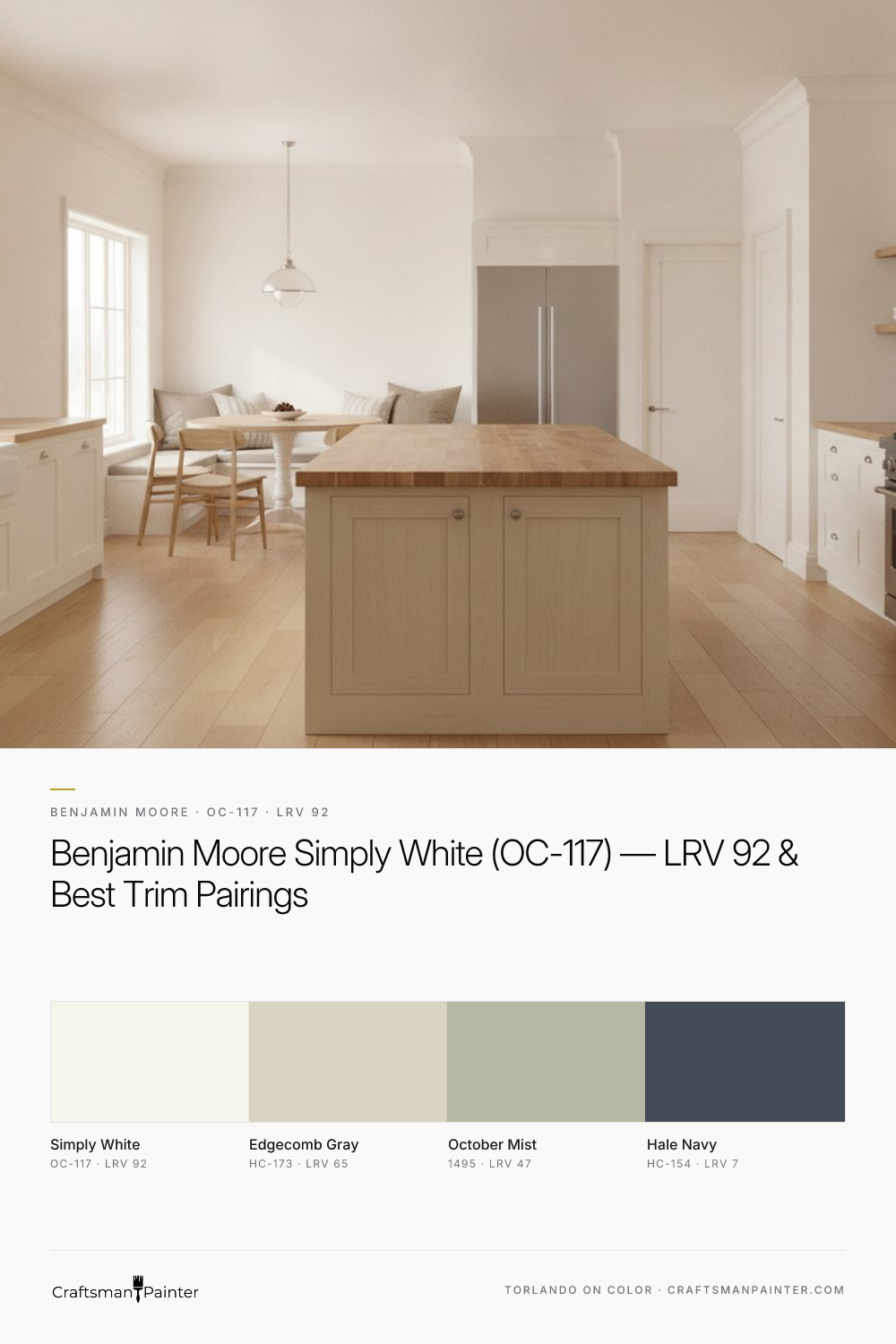


Simply White's Nuanced Warmth and Brightness
Real-paint peel-and-stick samples ship via Samplize. Craftsman Painter may earn a small commission on sample orders at no extra cost to you.
Simply White's high LRV of 92 indicates its exceptional ability to reflect light, contributing to a bright and airy feel in any space. This makes it an excellent choice for rooms that lack natural light, helping to visually expand the area. What distinguishes Simply White from other high-LRV whites is its subtle underlying warmth. While many perceive it as a crisp, clean white, a closer look reveals a very slight yellow-green undertone. This isn't a strong, obvious yellow, but rather a hint that softens the white, preventing it from appearing sterile or overly stark, particularly in cooler light conditions.
In north-facing rooms, where natural light tends to be cooler and bluer, Simply White's subtle yellow-green undertone helps to counteract the cool cast, preventing the color from feeling cold. Instead, it maintains a gentle warmth and brightness. In south-facing rooms or those with abundant natural light, this warmth becomes more apparent, leaning slightly into a creamy, inviting white without ever appearing yellow. Under artificial lighting, particularly warm-toned LEDs, the yellow-green aspect can be subtly enhanced, contributing to a cozy ambiance. This adaptability is a significant reason for its widespread appeal; it's a white that works hard to feel welcoming in diverse lighting environments. Understanding this subtle complexity is key to leveraging Simply White effectively in your home's design.
Crafting a Cohesive Palette: Simply White's Ideal Partners
When considering Simply White for your walls, selecting complementary colors for trim, ceilings, and accent features is crucial for a harmonious outcome. For trim and ceilings, using Simply White itself in a different sheen (e.g., matte on walls, satin or semi-gloss on trim) creates a seamless, enveloping effect, allowing the wall color to truly shine without interruption. If a slight contrast is desired, a cleaner white with minimal undertones, such as Benjamin Moore Chantilly Lace (OC-65), can provide a crisp edge without competing with Simply White's gentle warmth.
The coordinating palette provided offers excellent options for layering depth and interest. Benjamin Moore Edgecomb Gray (HC-173, LRV 65) is a versatile greige that can work beautifully as a complementary wall color in an adjacent space, or even as a ceiling color to add subtle definition, particularly in rooms with higher ceilings. For trim, if Simply White is on the walls, Edgecomb Gray would introduce a noticeable contrast, giving the trim a distinct, slightly warmer gray presence. This can be a sophisticated look in certain contexts, though it's less common than pairing a white wall with a white trim.
Benjamin Moore October Mist (1495, LRV 47) serves as an earthy, muted green coordinating neutral. Its organic quality beautifully complements Simply White's subtle green undertone, creating a serene and natural feel. This pairing works well in spaces where you want to evoke a connection to the outdoors. For a dramatic contrast, Benjamin Moore Hale Navy (HC-154, LRV 7) is an excellent choice. This deep, rich navy blue provides a striking anchor, making Simply White appear even brighter and cleaner. It's ideal for accent walls, cabinetry, or even exterior door colors.
When applying these colors, proper surface preparation is paramount. For drywall, aim for at least a Level 2: Standard finish, ensuring seams are taped and mudded smoothly. For a truly luxurious, seamless appearance, especially with high-LRV whites, a Level 3: Premium finish is recommended, involving skim coating and meticulous sanding. For walls, I often specify Sherwin-Williams Cashmere Low Lustre or Emerald Interior Matte for their smooth finish and excellent hide. In high-humidity areas like bathrooms and kitchens, Sherwin-Williams Duration Home provides superior moisture resistance and scrubbability. For baseboards, doors, and cabinetry, Emerald Urethane Trim Enamel in Satin or Semi-Gloss delivers a durable, chip-resistant finish that holds up to daily wear. For further exploration of these and other color possibilities, you can visit our Color Studio.
The Critical Comparison: Simply White vs. Its Rivals
Understanding a paint color often comes down to how it performs against its closest relatives. For Simply White, two common comparisons are Benjamin Moore White Dove (OC-17) and Chantilly Lace (OC-65).
Simply White (OC-117) vs. White Dove (OC-17): While both are popular warm whites, their undertones and LRVs distinguish them. Simply White, with an LRV of 92, is brighter and has that very subtle yellow-green undertone that keeps it from being stark. White Dove, with an LRV of 85, is noticeably softer and carries a more pronounced greige or gray undertone. This makes White Dove feel a bit creamier and more muted, especially in certain lights, where it can lean slightly into a soft off-white. If you want a brighter, cleaner white with just a kiss of warmth, Simply White is the choice. If you prefer a softer, more traditional off-white that feels more established and less crisp, White Dove is often the better fit.
Simply White (OC-117) vs. Chantilly Lace (OC-65): These two share a very high LRV (Chantilly Lace is also 92), meaning they are equally bright. However, their character is fundamentally different. Chantilly Lace is often considered Benjamin Moore's cleanest, purest white, with virtually no discernible undertones. It's a true, crisp white that reflects light without adding any discernible color bias. Simply White, in contrast, carries that subtle yellow-green warmth. Choosing between them depends entirely on the desired effect. If you seek absolute purity and a modern, gallery-like crispness, Chantilly Lace delivers. If you want that same level of brightness but with an inviting, softer edge that feels less clinical, Simply White is the superior option.
When evaluating these options, it's crucial to test real-paint peel-and-stick samples in your home. Josef Albers' principle of simultaneous contrast dictates that colors are perceived differently based on their surroundings. Holding a new paint sample directly against an existing painted wall will mislead your eye, as the old color will influence how you see the new one. To get an accurate read, isolate your samples by placing them against a pure white background (like a large piece of white poster board) or, ideally, against the actual white trim you intend to use. Observe them at different times of day and under various lighting conditions. If you're still unsure, a 1-on-1 Color Consultation can provide tailored guidance for your specific space and lighting.
Practical Considerations and My Recommendation
Benjamin Moore Simply White's versatility makes it an excellent candidate for various applications throughout the home. It performs exceptionally well as a wall color, providing a bright yet inviting backdrop that allows furnishings and artwork to stand out. Its subtle warmth prevents large expanses of white from feeling cold or impersonal. It is also a fantastic choice for trim and doors, especially when paired with warmer wall colors or when used universally on walls, trim, and ceilings for a cohesive, expansive feel. For kitchen cabinets, Simply White is a perennial favorite, offering a clean, fresh look that complements a wide array of countertop and backsplash materials. Its slight warmth helps it avoid the starkness that some pure whites can exhibit in a kitchen setting.
Regarding lighting, Simply White is particularly forgiving. In north-facing rooms, its yellow-green undertone provides a much-needed warmth, preventing the space from feeling dim or chilly. In south-facing or west-facing rooms, where light can be intense and warm, Simply White maintains its clean appearance without leaning too heavily into yellow, thanks to its balanced undertones. Under various artificial light sources, it generally holds its character well, though cooler LED temperatures might emphasize its clean aspect, while warmer temperatures can bring out a touch more creaminess.
As a high-LRV white, Simply White will naturally show dirt, scuffs, and imperfections more readily than darker colors. This is a practical consideration for high-traffic areas or homes with active families and pets. Selecting a durable, scrubbable paint finish, as discussed earlier, is essential to maintain its pristine appearance over time. Overall, I recommend Benjamin Moore Simply White for homeowners seeking a versatile, bright white that offers a touch of warmth and sophistication without veering into overly creamy or stark territory. It’s a reliable choice for creating spaces that feel fresh, open, and inviting, adapting beautifully to different lights and styles while providing a timeless foundation for your home's aesthetic.
Frequently Asked Questions
What are Benjamin Moore Simply White's undertones?
Benjamin Moore Simply White (OC-117) has subtle warm yellow-green undertones. This nuance prevents it from appearing stark or cold, giving it a gentle, inviting warmth without becoming overtly yellow or creamy. These undertones are most noticeable in cooler light, where they help to balance the overall feel of the room.
How does Simply White compare to White Dove?
Simply White (OC-117) has an LRV of 92 and a subtle yellow-green undertone, making it a very bright, clean white with a touch of warmth. White Dove (OC-17), with an LRV of 85, is a softer, slightly creamier off-white with a noticeable greige or gray undertone. Simply White is brighter and crisper, while White Dove offers a more muted, traditional warmth.
Is Simply White a good choice for kitchen cabinets?
Yes, Benjamin Moore Simply White is an excellent choice for kitchen cabinets. Its high LRV of 92 provides a bright, fresh, and clean look, while its subtle warm yellow-green undertones prevent the cabinets from appearing stark or sterile. This balance makes it versatile for various kitchen styles and complements a wide range of countertop and backsplash materials.
What trim color pairs best with Simply White walls?
For Simply White walls, the most cohesive trim pairing is often Simply White itself, used in a different sheen (e.g., satin or semi-gloss for trim). This creates a seamless, elegant look. Alternatively, for a crisp, clean contrast, Benjamin Moore Chantilly Lace (OC-65) can be used on trim, as its pure white character provides a sharp definition without competing with Simply White's subtle warmth.

Decoding the Brilliant Alchemy of Sherwin-Williams Sea Salt in High Summer

Sherwin Williams Sea Salt (SW 6204): The Only Coastal Color Your Columbus Home Needs
