
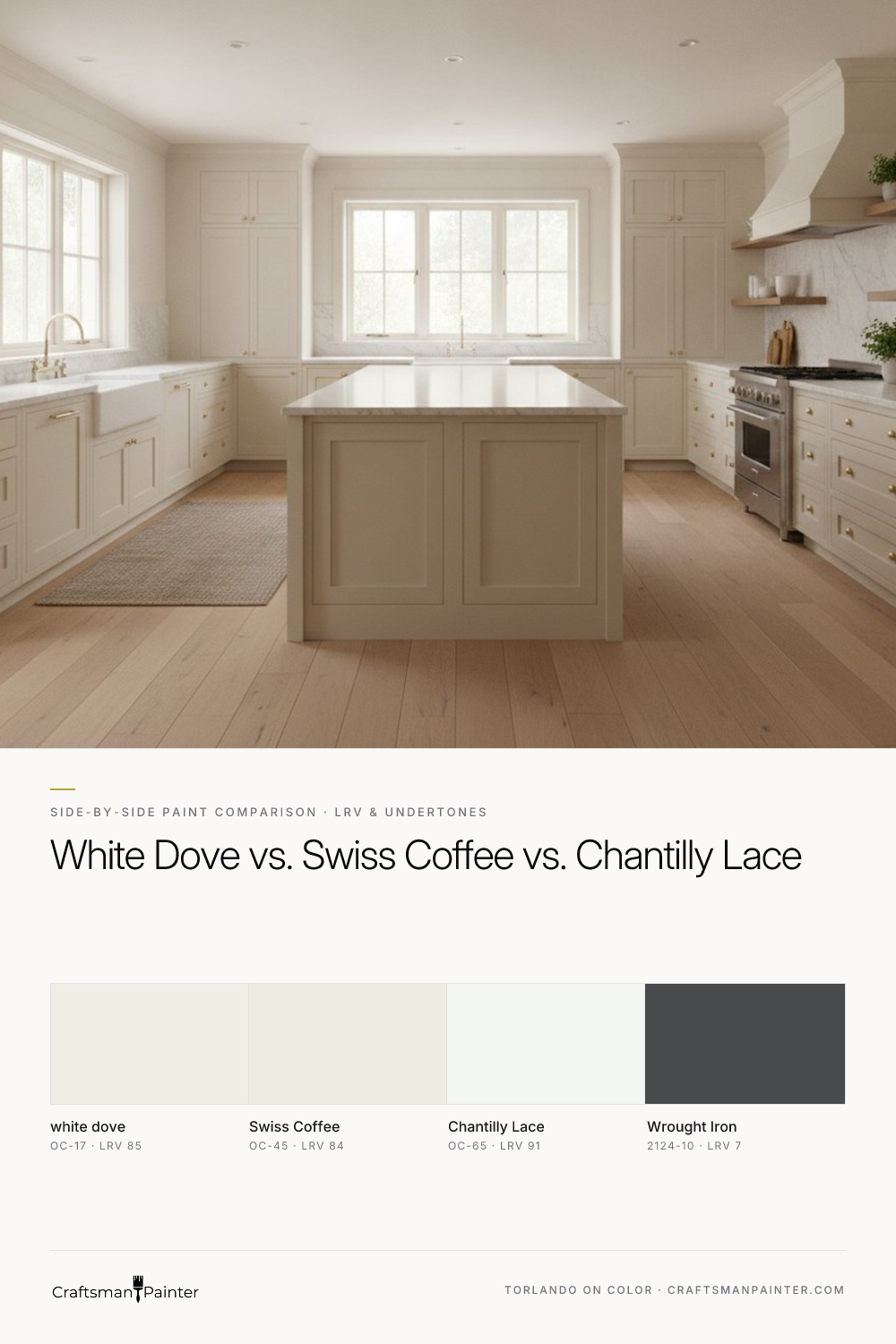


Before we dive into the specifics, it's critical to approach paint sampling correctly. Relying on small paper swatches or painting directly onto an existing colored wall can be highly misleading due to Josef Albers' principle of simultaneous contrast. Our eyes perceive colors differently based on their adjacent hues. A white swatch on a yellow wall will appear cooler than it truly is, and vice-versa. To accurately test, invest in large, real-paint peel-and-stick samples. Isolate these samples against a true white background—like a clean sheet of printer paper or existing white trim—and observe them in different lighting conditions throughout the day. This method provides the most reliable representation of how the color will behave in your home.
LRV & Brightness Gap on Full Walls
Real-paint peel-and-stick samples ship via Samplize. Craftsman Painter may earn a small commission on sample orders at no extra cost to you.
Light Reflectance Value (LRV) is a crucial metric, indicating how much visible light a paint color reflects. It ranges from 0 (absolute black) to 100 (absolute white). The higher the LRV, the more light a color reflects, making a room feel brighter and more expansive. Let's compare our contenders:
- Benjamin Moore Chantilly Lace (OC-65): LRV 91. This is the brightest of the three, reflecting a significant amount of light. On full walls, Chantilly Lace will appear crisp, clean, and provide maximum illumination. It is often chosen for spaces where a truly stark, modern white is desired, or in rooms with limited natural light to enhance brightness.
- Benjamin Moore White Dove (OC-17): LRV 85. With an LRV of 85, White Dove is still a bright white, but noticeably softer than Chantilly Lace. On full walls, it offers a gentle glow, reflecting ample light without feeling stark or clinical. It’s a versatile choice that feels inviting and airy.
- Benjamin Moore Swiss Coffee (OC-45): LRV 84. Sharing a very similar LRV to White Dove, Swiss Coffee reflects almost the same amount of light. However, its perceived brightness on full walls will be slightly softer and warmer due to its undertones. While still a bright white, it creates a more enveloping, cozy atmosphere than White Dove, and certainly more so than Chantilly Lace.
The difference between an LRV of 91 and 85, or even 84, is substantial on full walls. Chantilly Lace will actively lighten a room, while White Dove and Swiss Coffee will soften it, providing warmth and depth without sacrificing overall brightness.
Undertone Differences: North vs. South Light & 2700K Evening Bulbs
Undertones are the subtle colors that reveal themselves under varying lighting conditions, defining a white's character.
-
Benjamin Moore White Dove (OC-17): This white carries a subtle warm yellow-green undertone. In north-facing rooms, which receive cooler, indirect light, White Dove's warmth prevents it from appearing cold or sterile, offering a gentle, soft presence. In south-facing rooms, bathed in warm, direct sunlight, its yellow-green undertone is enhanced, making it appear even creamier and more inviting. Under 2700K evening bulbs (warm white), the yellow-green is further amplified, creating a cozy and distinctly warm ambiance.
-
Benjamin Moore Swiss Coffee (OC-45): Swiss Coffee is a distinctly warmer white than White Dove, often perceived as having a creamy, slightly beige or greige undertone. In north-facing rooms, its inherent warmth is a significant asset, effectively counteracting the cool, grey light to create a more welcoming and less stark environment. In south-facing rooms, it becomes wonderfully soft, rich, and deeply creamy, embracing the warm light. With 2700K evening bulbs, Swiss Coffee leans heavily into its creamy, almost buttery character, fostering a very comfortable and relaxed atmosphere.
-
Benjamin Moore Chantilly Lace (OC-65): Known for its exceptional cleanliness and minimal undertones, Chantilly Lace is often described as a true, crisp white. In north-facing rooms, it maintains its pure white character, appearing bright and airy, reflecting the cool light without adding color. In south-facing rooms, it remains a clean, brilliant white, feeling expansive and fresh. Under 2700K evening bulbs, while the warmth of the bulb will soften its sharp edges slightly, Chantilly Lace will still read as a very clean, neutral white, avoiding any yellowing or creaminess.
Pairing with Finishes: Oak, Marble, Quartz, or Cabinetry
The success of a white paint color often hinges on how it harmonizes with fixed elements in your home.
-
Warm Oak Floors: For homes with prominent warm oak floors, both White Dove and Swiss Coffee are excellent choices. White Dove's subtle yellow-green undertone harmonizes beautifully with the natural warmth of oak, providing a gentle contrast that feels cohesive. Swiss Coffee, with its deeper creamy character, can make oak floors feel grounded and rich, creating a sophisticated and inviting space. Chantilly Lace, while providing a stark, modern contrast, can sometimes make oak floors appear more yellow or dated if not balanced with other contemporary elements. It demands a more intentional design approach to avoid visual tension.
-
White Marble/Quartz Countertops: This is where Chantilly Lace truly shines. Its clean, neutral character perfectly complements the crisp, often cool tones of white marble and quartz, ensuring a seamless and elegant look. White Dove can work for a softer aesthetic, but its yellow-green undertone might subtly emerge against very cool white stone, making the stone appear cooler or the paint warmer than intended. Swiss Coffee is generally not recommended here; its creaminess will clash with pure white marble or quartz, potentially making the stone look dingy or the paint appear overly yellow.
-
Cabinetry: All three can be used effectively on cabinetry, often painted with a durable coating like Sherwin-Williams Emerald Urethane Trim Enamel in Satin or Semi-Gloss. Chantilly Lace provides a bright, modern, and expansive feel, ideal for contemporary kitchens. White Dove offers a classic, inviting look, versatile for traditional and transitional styles. Swiss Coffee lends itself to a cozier, perhaps European farmhouse or slightly vintage aesthetic, providing substantial warmth. Your choice should align with the overall style and the other finishes in the space.
Decision Rules, Sheens, and Preparation Recommendations
Choosing the right white comes down to your desired outcome and existing elements. For further exploration of these and other colors, you can visit our Color Studio.
When to choose Chantilly Lace (OC-65):
- You desire the cleanest, brightest white possible.
- Your space benefits from maximum light reflection.
- You have cool-toned white marble or quartz, and wish for a crisp, cohesive look.
- Your aesthetic is modern, minimalist, or you want a stark contrast with darker elements, such as Benjamin Moore Wrought Iron (2124-10) on an accent wall or interior doors.
When to choose White Dove (OC-17):
- You seek a versatile, soft white that offers warmth without being overtly creamy.
- Your home has warm wood tones (like oak) that you want to complement gently.
- You prefer a classic or transitional aesthetic that feels inviting and airy.
- You want a reliable white that performs consistently across different lighting conditions.
When to choose Swiss Coffee (OC-45):
- You desire a distinctly warm, creamy white that feels enveloping and cozy.
- Your home has natural wood tones or earthy elements that you wish to enhance with a softer white.
- You want to create a relaxed, comfortable atmosphere, especially in rooms with cooler natural light.
Sheen Recommendations:
- Walls: For a sophisticated, low-sheen finish, I recommend Sherwin-Williams Cashmere Low Lustre or Emerald Interior Matte. These finishes minimize imperfections and provide a rich, velvety appearance.
- Humid Areas (Baths/Kitchens): Sherwin-Williams Duration Home in Matte or Satin offers enhanced durability and moisture resistance.
- Trim, Doors, Cabinets: For a durable, cleanable surface, Sherwin-Williams Emerald Urethane Trim Enamel in Satin or Semi-Gloss is the professional standard. Its exceptional flow and leveling properties result in a smooth, factory-like finish.
Preparation Recommendations: Achieving a premium finish, especially with white paint, relies heavily on thorough surface preparation. For most occupied homes, Level 2: Standard (Occupied Home) preparation involves patching minor imperfections, light sanding, and a comprehensive priming. For a truly luxurious, glass-smooth finish, particularly on trim and cabinetry, Level 3: Premium (Luxury Finish) preparation is essential. This includes more extensive repairs, potentially a full skim coat on drywall, fine sanding between coats, and a high-quality primer. This meticulous approach ensures that the chosen white color looks its absolute best, free from surface distractions.
Navigating the world of white paint can be complex, but with a clear understanding of LRV, undertones, and proper testing, you can make an informed decision. If you find yourself needing further personalized guidance, consider a 1-on-1 Color Consultation to ensure your home's palette is perfectly tailored to your vision.

Can a High-Reflectance White Feel Soft Instead of Sterile? The Case for Benjamin Moore Frostine AF-5

Against Natural Stone and Cedar Trim, Benjamin Moore Stonybrook 1566 Delivers a Grounded Slate That Never Turns Baby Blue
