


Cultivating Serenity in Living & Dining Spaces
Real-paint peel-and-stick samples ship via Samplize. Craftsman Painter may earn a small commission on sample orders at no extra cost to you.
In primary living areas such as living rooms and formal dining rooms, Farrow & Ball Pigeon (No. 25) excels at creating an atmosphere of calm sophistication. Its earthy olive-taupe undertones provide a grounding presence, making these spaces feel established and inviting. In rooms with ample natural light, Pigeon can lean slightly more towards its green-grey characteristics, appearing fresh and airy. Conversely, in north-facing rooms or during evening hours, its deeper taupe notes become more prominent, creating a cozy, intimate ambiance. This chameleon-like quality is part of its appeal, ensuring the color never feels static.
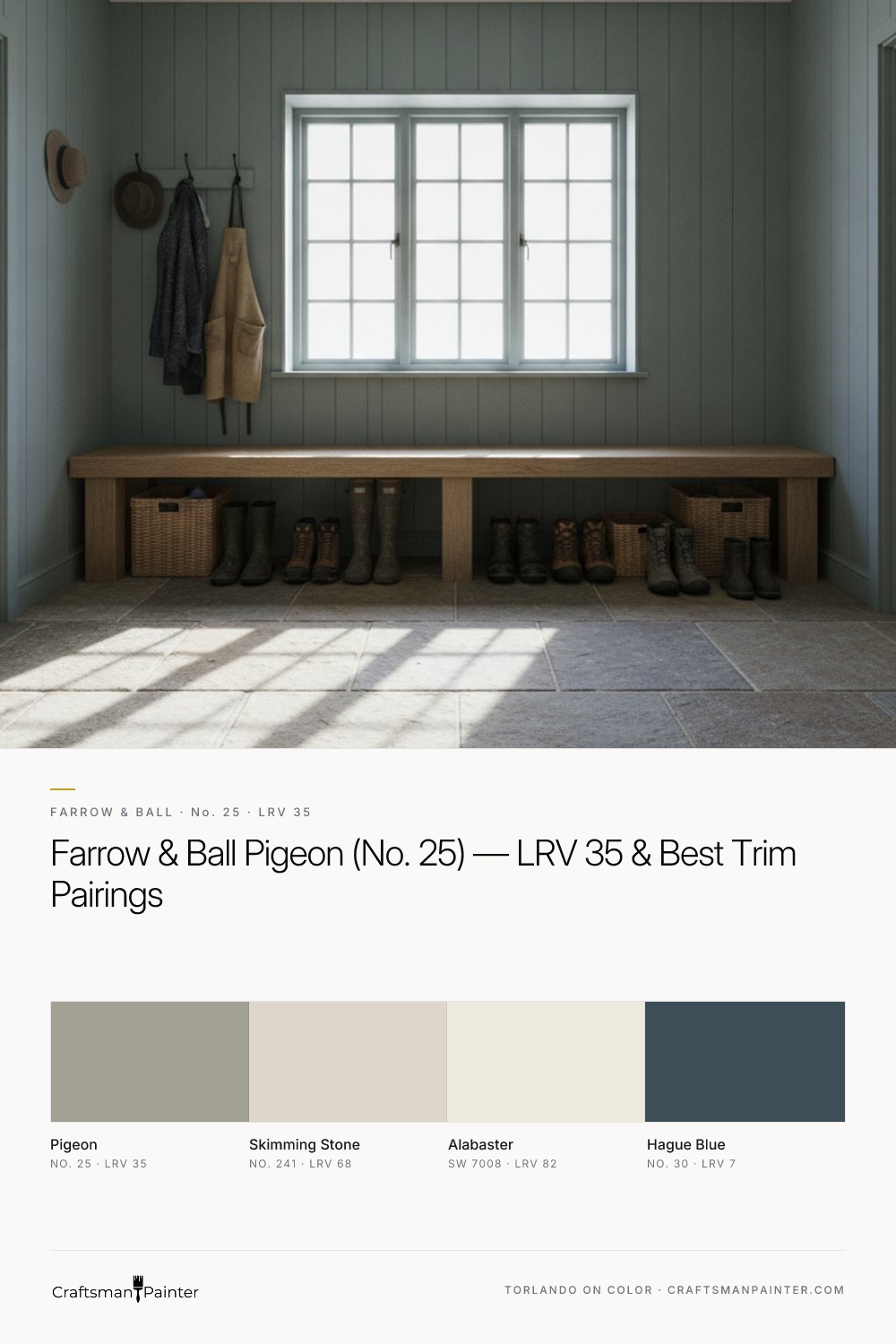
For trim and ceilings in these areas, Farrow & Ball Skimming Stone (No. 241, LRV 68) offers a soft, harmonious partnership. Its warm, off-white quality provides a gentle contrast that highlights architectural details without starkness. For a secondary neutral on adjacent walls or for larger pieces of millwork, Sherwin-Williams Alabaster (SW 7008, LRV 82) brings a brighter, yet still soft, counterpoint. To introduce an accent, Farrow & Ball Hague Blue (No. 30, LRV 7) provides a deep, dramatic contrast that can be used on a feature wall, built-in cabinetry, or even in textiles and furnishings. When applying Pigeon to drywall in living spaces, I typically recommend Sherwin-Williams Cashmere Low Lustre for its smooth finish and subtle sheen, or Emerald Interior Matte for a more durable, washable surface, especially in high-traffic areas. For existing wood trim or new millwork, ensure proper preparation, aiming for a Level 2: Standard (Occupied Home) finish, which includes patching minor imperfections and thorough sanding, before applying two coats of Emerald Urethane Trim Enamel in Satin for a subtle gleam.
A Grounding Presence in Private Quarters and Home Offices
Moving into more private spaces like bedrooms or home offices, Farrow & Ball Pigeon maintains its elegant composure, fostering environments conducive to rest and focused work. In a bedroom, its soothing depth can promote a sense of tranquility, making the space feel like a true retreat. Paired with natural textures like linen and wood, Pigeon accentuates an organic, understated luxury. For a home office, it provides a sophisticated backdrop that minimizes distractions while maintaining a professional aesthetic. The earthy undertones prevent it from feeling sterile, encouraging creativity and calm.
Consider using Pigeon on all four walls in a bedroom for an immersive experience, or on accent walls in a home office to define specific zones. The pairing with Skimming Stone on trim and ceilings continues to be effective here, maintaining visual continuity while allowing Pigeon to be the star. For a softer, less defined ceiling, Skimming Stone in a flat finish works well. In these personal spaces, the goal is often comfort and visual quietude, which Pigeon delivers with remarkable consistency. For walls, Emerald Interior Matte is an excellent choice for its low-sheen, durable finish, providing a rich depth of color that stands up to daily life.
Practicalities in Kitchens, Bathrooms & Hallways
When considering Farrow & Ball Pigeon for high-humidity areas like kitchens and bathrooms, or high-traffic zones like hallways, practical coating choices become paramount. While Pigeon’s aesthetic appeal is undeniable, the paint itself needs to withstand more demanding conditions. For kitchen walls, particularly near cooking zones, and for bathroom walls, I recommend Sherwin-Williams Duration Home. This coating is engineered for enhanced moisture resistance and scrubbability, making it ideal for areas prone to splashes and steam. In these applications, a matte or eggshell finish works well to balance durability with the desired aesthetic.
For kitchen cabinetry, which often sees significant wear, and for bathroom vanities, Emerald Urethane Trim Enamel in a Satin or Semi-Gloss finish is the professional standard. This coating provides exceptional hardness, resistance to chipping, and excellent washability. Achieving a premium finish on cabinetry often requires a Level 3: Premium (Luxury Finish) preparation, involving meticulous sanding, filling of grain, and multiple primer coats to create a glass-smooth surface before applying the topcoats. For hallways, where scuffs and marks are common, Duration Home also proves its worth. The LRV of 35 means Pigeon absorbs a fair amount of light, so ensure adequate artificial lighting in hallways to prevent them from feeling too dim. For those considering a full color transformation, our Color Studio offers further insights into this versatile shade.
Testing Pigeon & Its Closest Rivals
Selecting the right paint color requires careful consideration, and Farrow & Ball Pigeon is no exception. A common mistake homeowners make is painting swatches directly onto an existing colored wall. This approach is misleading due to Josef Albers' principle of simultaneous contrast, where the surrounding color drastically alters our perception of the swatch. To accurately assess Pigeon, I advise using large, real-paint peel-and-stick samples. Place these samples against a clean white background, such as a piece of poster board or directly against existing white trim. Observe them in different lighting conditions throughout the day to understand how the earthy olive-taupe undertones shift.
When comparing Farrow & Ball Pigeon to rival shades, two prominent contenders are Sherwin-Williams Evergreen Fog (SW 9130) and Benjamin Moore October Mist (1495). While all three share a muted, green-grey-taupe family resemblance, their nuances are distinct. Pigeon, with its LRV of 35, is generally deeper and more saturated than both. Its olive-taupe undertone is pronounced, giving it an organic, almost heritage feel. Sherwin-Williams Evergreen Fog (LRV 30) is slightly darker, leaning more explicitly into a muted green-grey, often perceived as a touch cooler and more overtly green. Benjamin Moore October Mist (LRV 46.5), on the other hand, is lighter and often reads as a softer, more desaturated sage green with noticeable grey. It lacks the deeper taupe and olive complexity that defines Pigeon. Understanding these subtle differences is key to selecting the perfect shade for your project. If you find yourself navigating these complexities, a professional 1-on-1 Color Consultation can provide tailored guidance, ensuring confidence in your final selection.
Frequently Asked Questions
What are Farrow & Ball Pigeon's undertones?
Farrow & Ball Pigeon (No. 25) primarily features earthy olive-taupe undertones. Depending on the light, these can lean more towards a muted green-grey or a deeper, warm taupe, giving it a complex and sophisticated character.
Is Farrow & Ball Pigeon a warm or cool color?
Farrow & Ball Pigeon is best described as a balanced neutral that leans slightly warm due to its prominent olive-taupe undertones. While it has grey influences, the warmth from the olive and taupe prevents it from feeling overtly cool, making it versatile across various lighting conditions.
What trim colors pair best with Farrow & Ball Pigeon?
For trim and ceilings, Farrow & Ball Skimming Stone (No. 241) is an excellent pairing, offering a soft, harmonious off-white contrast. Sherwin-Williams Alabaster (SW 7008) also works well as a brighter, yet still soft, coordinating neutral for trim or adjacent walls.
How does Farrow & Ball Pigeon compare to Sherwin-Williams Evergreen Fog?
Farrow & Ball Pigeon (LRV 35) is an earthy olive-taupe, generally deeper and more saturated with a distinct organic feel. Sherwin-Williams Evergreen Fog (SW 9130, LRV 30) is slightly darker and leans more explicitly into a muted green-grey, often appearing a touch cooler and more overtly green than Pigeon.

Warm Gray and Muted Green Converge in the Quiet Depth of Sherwin-Williams Ellsworth (SW 7650)

Beyond Predictable Neutrals: The Burnished Authority of Sherwin-Williams Tarnished Treasure (SW 9118)
