
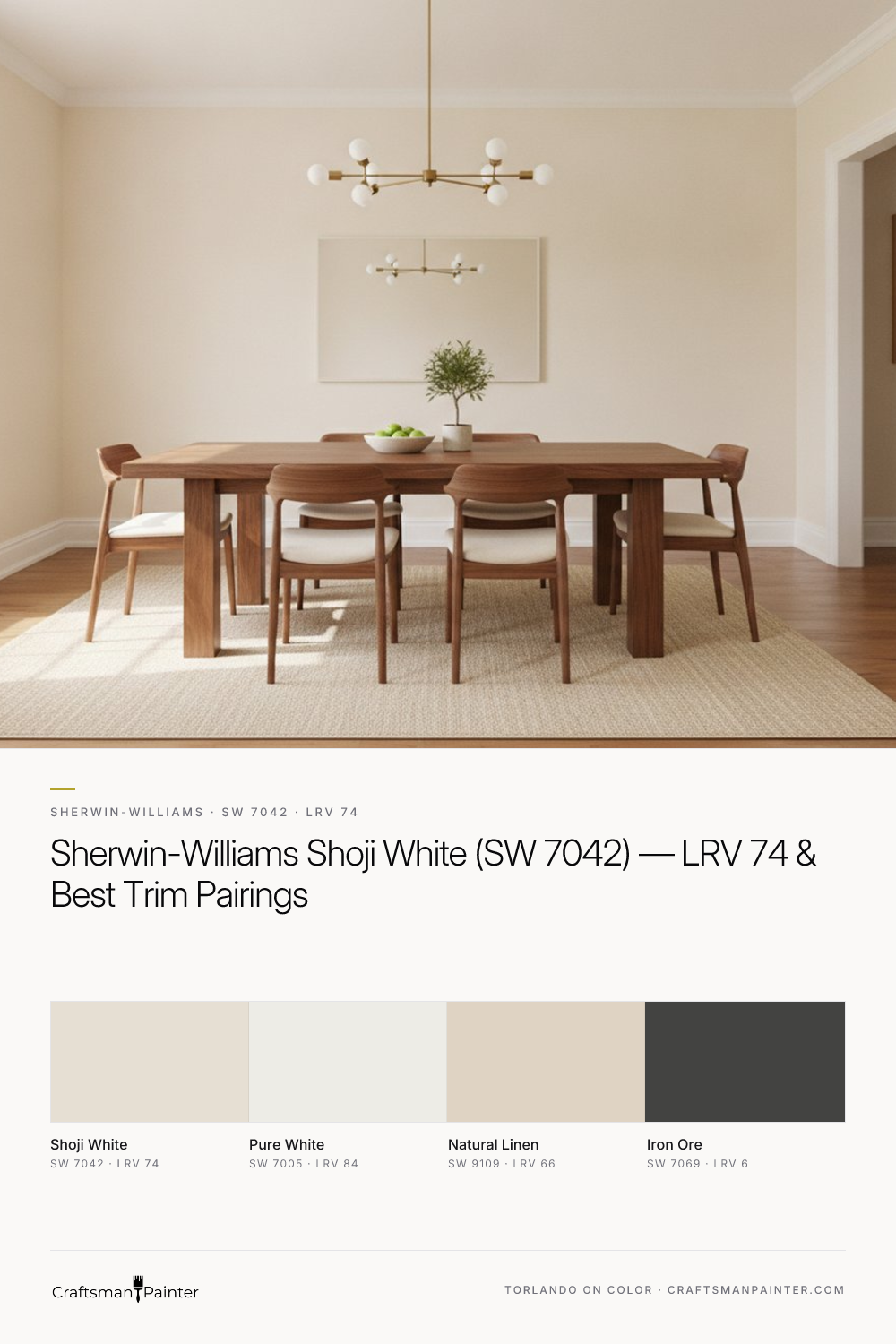


The Nuance of Shoji White's Warmth and Light Interaction
Real-paint peel-and-stick samples ship via Samplize. Craftsman Painter may earn a small commission on sample orders at no extra cost to you.
With an LRV (Light Reflectance Value) of 74, Shoji White sits comfortably in the off-white category, reflecting a significant amount of light while retaining a discernible body of color. This isn't a stark, clinical white; rather, it possesses a soft, warm cream-yellow undertone that reveals itself gently under varying light conditions. In north-facing rooms, where natural light tends to be cooler and bluer, Shoji White’s inherent warmth helps to counteract the chill, preventing the space from feeling cold or stark. Conversely, in south-facing rooms or those bathed in abundant warm light, its creamy quality is enhanced, creating a serene and sun-kissed atmosphere without becoming overly yellow.
Properly evaluating Shoji White, or any paint color, demands careful consideration of its surroundings. Josef Albers’ principle of simultaneous contrast dictates that the perceived color of a swatch is heavily influenced by the colors adjacent to it. This means testing a paint sample directly against an existing painted wall will inevitably lead to a misleading perception of the new color. The old wall color will distort your view of Shoji White, making it appear either warmer or cooler, brighter or duller, than it truly is. To gain an accurate understanding, always isolate real-paint peel-and-stick samples on a white background, such as a piece of poster board, and then observe them against your existing white trim. This method allows you to see Shoji White in its truest form, interacting solely with the natural light and the architectural elements of your space. Rotate these samples throughout the day and in different areas of the room to observe how the light shifts its appearance.
Crafting a Cohesive Palette with Shoji White
Building a harmonious color scheme around Shoji White involves selecting complementary shades that enhance its subtle warmth without clashing. For trim and ceilings, my go-to pairing is Sherwin-Williams Pure White (SW 7005, Hex #EDECE6, LRV 84). Pure White is a clean, crisp white with barely perceptible cool undertones, making it an ideal partner for Shoji White. It provides the necessary contrast to make Shoji White feel rich and inviting, defining architectural details like baseboards, crown molding, and door casings without introducing any conflicting warmth. For a superior finish on these elements, I recommend Sherwin-Williams Emerald Urethane Trim Enamel in Satin or Semi-Gloss. This coating offers exceptional flow and leveling, resulting in a smooth, durable finish that stands up to daily wear. Preparing these surfaces often requires a Level 3: Premium finish, ensuring all imperfections are addressed before coating.
For coordinating neutrals, Sherwin-Williams Natural Linen (SW 9109, Hex #DFD3C3, LRV 66) is an excellent choice. This sophisticated off-white shares a similar underlying warmth with Shoji White but offers a deeper, more saturated presence, making it suitable for adjacent rooms, accent walls, or even as a cabinet color. It creates a subtle, layered effect that feels intentional and refined. To introduce a grounding contrast, Sherwin-Williams Iron Ore (SW 7069, Hex #434341, LRV 6) serves beautifully as an accent. Its deep, charcoal gray with subtle earthy undertones provides a strong anchor, perfect for a front door, an accent wall in a powder room, or even select furniture pieces. This combination ensures a balanced and inviting atmosphere. For walls, I typically specify Sherwin-Williams Cashmere Low Lustre for a soft, elegant finish, or Emerald Interior Matte for enhanced washability and durability, especially in high-traffic areas. You can explore how these colors interact and visualize them in different settings using our Color Studio tool.
Shoji White's Closest Rivals: Alabaster and Natural Linen
When homeowners are considering Shoji White, two other Sherwin-Williams shades frequently come into the discussion: Alabaster (SW 7008) and Natural Linen (SW 9109). Understanding their distinctions is crucial for making an informed decision.
Sherwin-Williams Alabaster (SW 7008) is often described as a soft, warm white with a slightly less pronounced yellow undertone than Shoji White. With an LRV of 82, Alabaster is notably brighter than Shoji White (LRV 74). While both are warm off-whites, Alabaster leans more towards a creamy, almost linen-like white, whereas Shoji White has a more discernible cream-yellow warmth. Alabaster feels a touch softer and often appears more purely white in well-lit spaces, making it a popular choice for those who desire warmth but want to stay closer to a true white. Shoji White, by contrast, offers a richer, more substantial body of color, making it feel slightly more colored and less like a "white." If you're seeking a white that clearly reads as warm and inviting without being overtly beige, Shoji White is an excellent contender. If you prefer a softer, brighter white that still carries warmth, Alabaster might be a better fit.
Natural Linen (SW 9109), as previously mentioned, is a deeper and more saturated version of the warm off-white family, with an LRV of 66. It shares the creamy, warm-yellow undertones found in Shoji White but presents them with greater intensity. While Shoji White functions beautifully as a primary wall color, Natural Linen often serves as a coordinating neutral, offering more depth and a slightly more traditional feel. Where Shoji White provides a gentle backdrop, Natural Linen makes more of a statement. If you find Shoji White a touch too bright or too subtle for your desired effect, Natural Linen offers a harmonious step down in brightness and a step up in color saturation, while maintaining a consistent warm aesthetic.
Real-World Application and Professional Finish Considerations
The versatility of Sherwin-Williams Shoji White extends across various rooms and functions within a home. It excels in open-concept living spaces, providing a unified, expansive feel that still offers warmth. In bedrooms, its soft, creamy undertones create a serene and restful environment, pairing beautifully with both light and dark furnishings. For kitchens and bathrooms, Shoji White is a strong contender for cabinetry and wall applications. When used in these high-humidity areas, I recommend Sherwin-Williams Duration Home Interior Acrylic Latex, which offers exceptional moisture resistance and durability, resisting mildew growth and making cleanup easier. For drywall surfaces throughout the home, ensuring proper preparation is paramount. A Level 2: Standard (Occupied Home) finish addresses minor imperfections, while a Level 3: Premium (Luxury Finish) is ideal for achieving a truly smooth, flawless surface, particularly important when using lower sheen paints like matte or low lustre.
Beyond interior walls, Shoji White can be a sophisticated choice for exterior applications, offering a warm, inviting curb appeal that avoids the starkness of pure white. Its LRV of 74 ensures it holds up well in bright sunlight, preventing it from washing out completely. However, exterior color selection always requires an on-site evaluation, as environmental factors like landscaping and neighboring homes can significantly alter perception.
Ultimately, achieving a professional and lasting finish with Shoji White, or any color, involves more than just selecting the right hue. It requires meticulous surface preparation, the use of high-quality coatings tailored to specific areas, and skilled application. For homeowners in Zionsville, IN, or those seeking virtual guidance across the US, my team and I are available to provide tailored advice. A 1-on-1 Color Consultation can help you navigate these choices, ensuring your selected palette truly enhances your home. Shoji White is not just a paint color; it's a foundational element for creating spaces that feel genuinely warm, sophisticated, and enduring.
Frequently Asked Questions
Is Sherwin-Williams Shoji White a warm or cool color?
Sherwin-Williams Shoji White (SW 7042) is distinctly a warm off-white. It features soft cream-yellow undertones that prevent it from feeling stark or cold, making it an inviting choice for various spaces. Its warmth helps counteract cooler natural light and enhances brighter, sunnier rooms.
What are the best trim colors to pair with Shoji White?
For trim and ceilings, Sherwin-Williams Pure White (SW 7005) is an ideal pairing with Shoji White. Its crisp, clean white provides a subtle contrast that allows Shoji White's warmth to stand out, defining architectural details without introducing conflicting undertones.
How does Shoji White compare to Sherwin-Williams Alabaster?
Shoji White (SW 7042, LRV 74) is warmer with more noticeable cream-yellow undertones than Alabaster (SW 7008, LRV 82). Alabaster is a brighter, softer warm white that leans more towards a creamy linen, while Shoji White offers a richer, more substantial body of color, making it feel slightly more 'colored' than Alabaster.
Is Shoji White suitable for kitchen cabinets or exterior use?
Yes, Shoji White is an excellent choice for kitchen cabinets, providing a warm and sophisticated look. For durability, use Sherwin-Williams Emerald Urethane Trim Enamel in Satin or Semi-Gloss. It is also suitable for exteriors, offering inviting curb appeal without being stark, though on-site evaluation is always recommended for exterior applications due to environmental factors.

Stop Painting Indiana Kitchens Bright White and Use This Earthy Cream Instead
The Accidental Pink: A Color Story on Finding the Perfect White
