
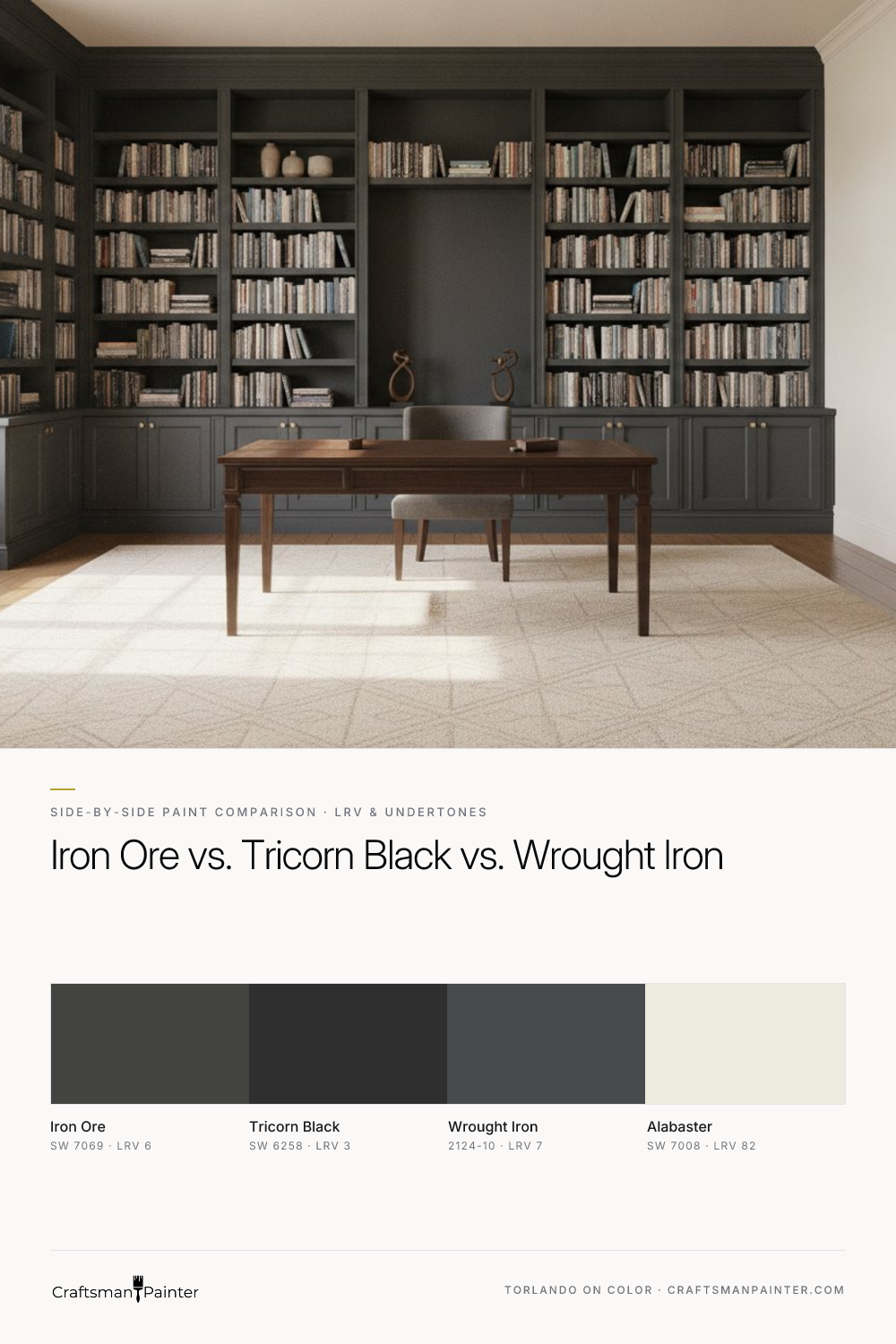


When evaluating paint colors, it is essential to use real-paint peel-and-stick samples. Applying a swatch directly to an existing painted wall can be misleading due to Josef Albers' principle of simultaneous contrast. The surrounding color will influence how your eye perceives the new swatch, distorting its true character. Always isolate your samples against a clean white background, such as Sherwin-Williams Alabaster (SW 7008), or position them against white trim to ensure an accurate assessment of their inherent qualities.
LRV and Brightness Gap: Full Walls vs. Accents
Real-paint peel-and-stick samples ship via Samplize. Craftsman Painter may earn a small commission on sample orders at no extra cost to you.
Light Reflectance Value (LRV) is a crucial metric, indicating how much light a color reflects. A higher LRV means more light reflected, making a space feel brighter. Conversely, a lower LRV absorbs more light, creating a deeper, more saturated look. Sherwin-Williams Tricorn Black (SW 6258) has an LRV of 3, making it one of the truest, most absolute blacks available. This low LRV means it will absorb nearly all light, presenting as a pure, stark black in almost any lighting condition. For full walls, Tricorn Black can feel incredibly dramatic, even oppressive, in spaces without abundant natural light. It is best reserved for accent walls or small, high-impact areas indoors if used on a full wall, or for bold, modern exteriors where a true black is desired.
Sherwin-Williams Iron Ore (SW 7069) has an LRV of 6, positioning it as a very deep charcoal, just shy of a true black. This slight increase in LRV over Tricorn Black allows it to retain a touch more softness and nuance. On a full wall, Iron Ore will read as a sophisticated, almost-black dark gray, offering depth without the absolute starkness of Tricorn Black. It’s a compelling choice for a dramatic dining room, a moody study, or a striking accent wall, feeling more approachable than Tricorn Black while still delivering significant visual weight. The subtle brightness gap between Iron Ore and Tricorn Black becomes more apparent on larger surfaces, where Iron Ore's charcoal quality is more discernible.
Benjamin Moore Wrought Iron (2124-10) has an LRV of 7, making it the lightest of the three contenders. This higher LRV means it will consistently appear as a very deep charcoal gray, rather than a near-black. On full walls, Wrought Iron offers a rich, sophisticated depth that is less intense than Iron Ore or Tricorn Black. It's an excellent choice for creating a cozy, enveloping atmosphere in a bedroom or den, or for a stylish powder room. Its slightly higher reflectivity makes it feel a bit more grounded and less imposing than its darker counterparts, allowing it to function effectively on full walls without overwhelming the space. The brightness differences, though seemingly small in LRV numbers, translate to distinct visual experiences on large surfaces.
Undertone Differences: North-Facing vs. South-Facing Rooms and 2700K Evening Bulbs
Understanding undertones is paramount, especially with deep, saturated colors that can shift dramatically under varying light. Sherwin-Williams Iron Ore (SW 7069) is celebrated for its clean, neutral undertone with minimal chromatic cast. In a north-facing room, which receives cooler, bluer light, Iron Ore maintains its deep charcoal integrity, leaning into a subtle, almost imperceptible cool gray. It avoids becoming overtly blue or purple, which can plague other dark grays. In a south-facing room, bathed in warm, yellow light, Iron Ore remains remarkably balanced, resisting the urge to turn green or muddy. Its neutrality is its strength, offering consistent depth. Under 2700K evening bulbs, which emit a warm, soft glow, Iron Ore retains its sophisticated charcoal identity, appearing slightly softer and more inviting than in brighter daylight, yet never losing its deep character.
Sherwin-Williams Tricorn Black (SW 6258) is a true, neutral black. It possesses virtually no discernible undertones. This makes it incredibly consistent across all lighting conditions. In north-facing rooms, it remains a pure black. In south-facing rooms, it remains a pure black. Under 2700K evening bulbs, it remains a pure black. Its lack of undertone is both its primary advantage and its potential drawback: it offers uncompromising depth and drama, but also no subtle shifts or complexities. For those seeking an absolute black, Tricorn Black delivers without hesitation.
Benjamin Moore Wrought Iron (2124-10) is a deep charcoal gray with a subtle, cool undertone. This cool cast becomes more apparent in north-facing rooms, where the blue light enhances its slight blue-gray lean. It never becomes overtly blue, but offers a sophisticated, muted coolness. In south-facing rooms, the warm light helps to balance this coolness, making it appear as a rich, deep charcoal with less of its blue influence. Under 2700K evening bulbs, Wrought Iron softens considerably, its cool undertone receding as the warm light emphasizes its gray depth, making it feel more cozy and less stark than in natural daylight. For those seeking a deep charcoal with a hint of sophisticated cool character, Wrought Iron is an excellent choice.
Which Shade Wins Against Warm Oak Floors, White Marble/Quartz, or Cabinetry
Pairing these deep shades with existing finishes requires strategic thinking. For homes with warm oak floors, the goal is to either complement or provide a striking contrast without clashing. Sherwin-Williams Iron Ore (SW 7069) is a strong contender here. Its neutral, deep charcoal provides a sophisticated contrast to warm oak, allowing the wood's warmth to shine without making the walls feel too stark. The subtle softness of Iron Ore prevents it from feeling harsh against the natural grain and color of oak. For built-ins or doors against oak, Iron Ore offers a grounded, elegant statement.
Sherwin-Williams Tricorn Black (SW 6258) against warm oak floors creates a bold, high-contrast look. This can be very modern and dramatic, but it requires careful consideration. If the goal is a stark, graphic aesthetic, Tricorn Black delivers. However, for some, the absolute black might feel too severe against the organic warmth of oak. It's a powerful choice for contemporary spaces where a definitive contrast is desired, particularly on interior doors or a fireplace surround.
Benjamin Moore Wrought Iron (2124-10), with its slightly cooler and softer charcoal presence, also works well with warm oak. Its subtle cool undertone can provide a sophisticated counterpoint to the oak's warmth, creating a balanced and refined aesthetic. It offers contrast without the intensity of Tricorn Black, making it a versatile option for cabinetry or built-ins in a room with oak floors, especially if you want a deep color that feels less imposing. Its slight blue-gray cast can actually enhance the richness of the oak.
When paired with white marble or quartz countertops and backsplashes, all three colors excel, but in different ways. Tricorn Black provides the ultimate crisp, dramatic contrast, making white elements pop with striking clarity. This is a classic, timeless combination for kitchens and bathrooms. Iron Ore offers a slightly softer contrast, creating a sophisticated and elegant pairing that is still impactful but perhaps less stark than Tricorn Black. Wrought Iron, with its deeper charcoal and subtle cool lean, provides a beautiful, modern contrast that feels a bit more nuanced and less absolute than Tricorn Black, allowing the white marble/quartz to stand out against a rich, architectural backdrop. For a comprehensive look at how Iron Ore performs in various settings, explore our Color Studio.
Clear Decision Rules and Sheen/Prep Recommendations
Choose Sherwin-Williams Tricorn Black (SW 6258) if:
- You require an absolute, pure black with no discernible undertones. This is the choice for maximum drama and graphic contrast.
- Your design aesthetic leans minimalist, modern, or industrial, where starkness is an asset.
- You are painting exterior elements like window frames, shutters, or a front door where a true, deep black will make a powerful statement. Its low LRV makes it hold its true color well outdoors.
Choose Sherwin-Williams Iron Ore (SW 7069) if:
- You desire a deep, sophisticated charcoal that reads as an almost-black but with a touch more softness and neutrality than a pure black.
- You want a highly versatile dark neutral that performs consistently across various lighting conditions without unwanted chromatic shifts.
- You are painting interior doors, built-ins, or a feature wall where significant depth is desired, but the absolute intensity of Tricorn Black might be too much.
- For exteriors, Iron Ore offers a softer, yet still impactful, deep charcoal that pairs beautifully with a wide range of materials and architectural styles.
Choose Benjamin Moore Wrought Iron (2124-10) if:
- You prefer a very deep charcoal gray with a subtle cool undertone, offering a sophisticated, architectural feel.
- You want a color that provides significant depth but is slightly less intense than Iron Ore, making it suitable for larger surfaces or rooms where an enveloping, moody atmosphere is desired without feeling overwhelming.
- Your existing finishes or desired aesthetic benefit from a charcoal with a nuanced cool character, especially when paired with natural wood tones or cooler whites.
Sheen and Preparation Recommendations:
For drywall, a matte or low lustre finish is generally preferred for deep colors as it helps to mask minor imperfections and provides a sophisticated, velvety appearance. For interior walls, Sherwin-Williams Cashmere Low Lustre or Emerald Interior Matte are excellent choices. In humid areas like bathrooms or kitchens, Sherwin-Williams Duration Home in a Matte or Satin finish offers enhanced durability and moisture resistance. For a truly premium finish on walls, ensuring Level 3: Premium drywall preparation is crucial, involving skim coating and meticulous sanding to achieve a glass-smooth surface before priming and painting. For standard occupied homes, Level 2: Standard preparation, addressing minor imperfections, is often sufficient.
For doors, built-ins, and cabinetry, a more durable, higher-sheen product is recommended for its washability and resistance to wear. Sherwin-Williams Emerald Urethane Trim Enamel in Satin or Semi-Gloss provides exceptional hardness and a smooth, furniture-like finish. Satin offers a soft sheen that is still highly durable, while Semi-Gloss provides more reflectivity and a crisper look. For wood surfaces, Level 3: Premium wood preparation, involving thorough cleaning, sanding, and filling of any imperfections, followed by an appropriate primer, is essential for achieving a high-quality, long-lasting finish. This meticulous approach ensures that the chosen deep color truly elevates the architectural elements. If you're still navigating these complex choices, consider a 1-on-1 Color Consultation for personalized guidance tailored to your specific home and vision.
Frequently Asked Questions
What is the main difference between Sherwin-Williams Iron Ore and Tricorn Black?
Sherwin-Williams Tricorn Black (SW 6258, LRV 3) is a true, neutral black with virtually no undertones, offering maximum drama and stark contrast. Sherwin-Williams Iron Ore (SW 7069, LRV 6) is a very deep charcoal that reads as an almost-black, but with a subtle neutrality that provides more softness and nuance, making it less intense than Tricorn Black while still impactful.
How do these colors perform in north-facing vs. south-facing rooms?
Tricorn Black remains a pure black in all lighting conditions due to its absolute neutrality. Iron Ore maintains its deep charcoal integrity in north-facing (cooler) rooms and stays balanced in south-facing (warmer) rooms, resisting unwanted chromatic shifts. Benjamin Moore Wrought Iron's subtle cool undertone is more apparent in north-facing rooms but softens in south-facing light.
Which of these deep colors is best for exteriors?
All three can work well for exteriors, depending on the desired effect. Tricorn Black offers an uncompromising, bold true black statement. Iron Ore provides a sophisticated, deep charcoal that is slightly softer than Tricorn Black but still highly impactful and versatile. Wrought Iron offers a rich, deep charcoal with a subtle cool character, providing depth without the absolute intensity of the other two.
What sheen and paint product should I use for doors and built-ins with these dark colors?
For maximum durability and a refined finish on doors, built-ins, and cabinetry, use Sherwin-Williams Emerald Urethane Trim Enamel in Satin or Semi-Gloss. Satin offers a softer sheen with excellent washability, while Semi-Gloss provides a crisper, more reflective look. Proper Level 3: Premium wood preparation, including thorough cleaning, sanding, and priming, is crucial for optimal results.

Immerse Yourself in Deep Greens: Isle of Pines SW 6461, Ripe Olive SW 6209, and Forestwood SW 7730

Tricorn Black: A Sophisticated Shade for the Modern Home
