


The Space & Craftsman's Brief
Real-paint peel-and-stick samples ship via Samplize. Craftsman Painter may earn a small commission on sample orders at no extra cost to you.
Walk down almost any established residential street in our project area, and you will see a familiar rhythm of exterior colors: dark taupes, slate blues, and muted forest greens. When a homeowner decides they want to be the red house on that block, the margin for error shrinks to zero. Go too bright, and the house looks like a firehouse or a novelty barn. Go too purple, and it clashes violently with the natural greens of the lawn and foundation plantings.
If you are going to be the red house on the block, Sherwin-Williams Dark Redwood (SW 2801) is the standard. Deep and grounded, it carries rich architectural depth without shouting for attention. Because of its heavy earthen base, it sits naturally alongside neighboring dark taupes, slate blues, and forest greens—delivering distinct character to the streetscape without disrupting the neighborhood's visual balance.
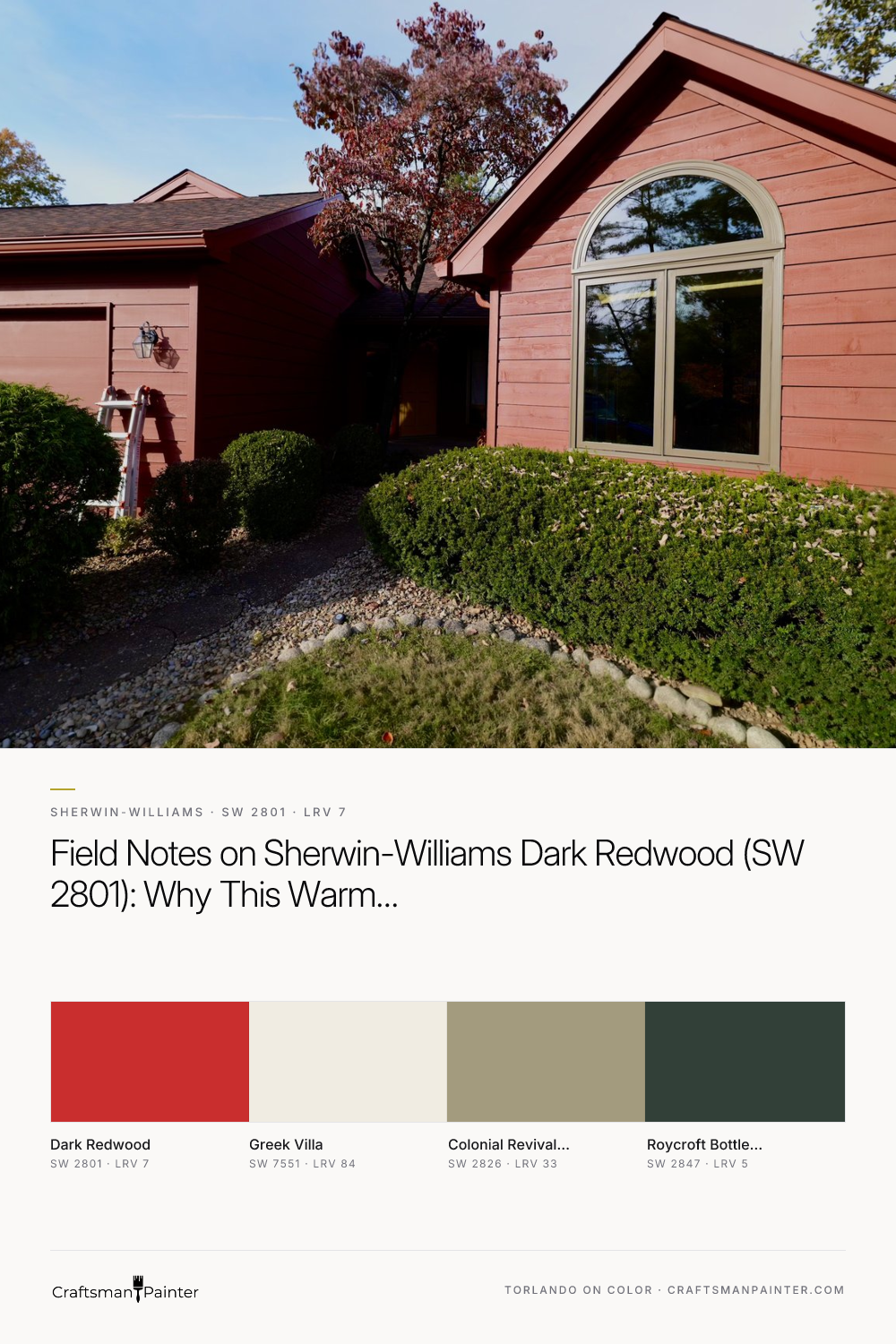
Looking at the architecture of this home, you can see why color selection was so critical. We are dealing with wide horizontal wood lap siding, deep soffit overhangs, an attached garage wing, and a prominent front gable featuring a large, contemporary arched window. We also had an existing fixed element right in the center of the composition: the factory-finished khaki-taupe cladding on that focal window, alongside a warm brown architectural shingle roof and an ornamental red-leaf tree right in the entry courtyard.
This project had its share of exterior hurdles—wood siding always demands patience, thorough moisture management, and serious prep—but our crew at Craftsman Painter is built on seeing complex jobs through and standing behind the work for the long haul.
Color Theory Deep-Dive: Sherwin-Williams Dark Redwood (SW 2801)
To understand why SW 2801 works so well on this façade, we have to look at its physical properties. Dark Redwood has a Light Reflectance Value (LRV) of 7. On a scale from 0 (absolute black) to 100 (pure reflective white), a 7 means this paint absorbs the vast majority of light that hits it.
However, exterior daylight is intense. Look closely at the photo above, and you will see a live demonstration of how LRV 7 behaves under direct sun versus deep shadow.
On the right-hand gable, where the direct afternoon sunlight strikes the rough-sawn texture of the wood siding, the warm brown and terracotta undertones of Dark Redwood come forward. The sun pulls out the iron-oxide warmth, making the wall feel inviting and earthy. Now, shift your eyes to the left, inside the recessed entry alcove beneath the roofline and behind the ornamental tree. Out of direct UV light, that exact same paint drops into a rich, brooding burgundy-brown shadow. That dynamic range between the sunlit gable and the shaded recess gives the home serious three-dimensional weight.
Because Dark Redwood is heavily anchored by warm brown and subtle burgundy undertones rather than bright crimson or orange, it handles shifts in lighting temperature gracefully:
- Morning Light: Cool, bluish eastern light pulls out the subtle burgundy base, making the house look stoic and traditional.
- Afternoon Sun: Direct western light warms up the red and brown pigments, connecting the siding directly to the brown roof shingles and the reddish foliage of the courtyard tree.
- Evening 3000K Exterior Lighting: Notice the coach light mounted next to the garage door. When night falls and warm 3000K bulbs kick on against these walls, the low LRV prevents harsh glare. Instead of bouncing light back into the yard, the siding absorbs the warm halogen or LED glow, creating a low-contrast, cozy perimeter around the garage and entryway.
Coordinating Palettes: Working with Fixed Elements
A smart exterior palette accounts for every material on the property, from the gravel walkways to the window frames. Here, we wrapped the fascia boards, soffits, downspouts, and the garage door in Dark Redwood to create a cohesive, monolithic envelope. When you paint the garage door the same deep shade as the body, it stops competing with the front entry for visual dominance.
If you are building a complete architectural scheme around Sherwin-Williams Dark Redwood (SW 2801), here is how I break down the coordinating palette:
- The Mid-Tone Bridge: Sherwin-Williams Colonial Revival Green Stone (SW 2826). Look at the existing metal window cladding on that large arched window in the photo. It sits right in the family of Colonial Revival Green Stone—an earthy, muted khaki with an olive-gray undertone. Because green sits opposite red on the color wheel, this olive-toned neutral cools down the warmth of the redwood siding without creating a jarring contrast.
- The Contrast & Accent: Sherwin-Williams Roycroft Bottle Green (SW 2847). With dense boxwoods and yews lining the stone path, bringing an ultra-dark, historic green like Roycroft Bottle Green onto a front entry door or shutters ties the building directly into its landscaping.
- The Trim & Anchor Neutral: Sherwin-Williams Greek Villa (SW 7551). If you prefer crisp trim rather than the monochromatic fascia approach we used here, avoid stark, bluish-white paints. A stark white against an LRV 7 red creates visual vibration that hurts the eyes in bright sunlight. Greek Villa has enough creamy, warm yellow undertone to bridge the gap peacefully with Dark Redwood's brown base.
Craftsman Field Notes: Executing Deep Reds on Wood Siding
Applying a deep-base red on exterior wood siding requires technical discipline. You can see our step ladder tucked right by the garage wall in the photo—a reminder of the hands-on detail work required around fixtures and joints. Here is what goes into making a finish like this last in our climate:
- Tinted Primer is Non-Negotiable: Pigments in the red family are notoriously translucent. If you apply Dark Redwood over white primer or bare patched wood, it will take four coats to achieve uniform hide, and the color will look weak. We always use a gray- or red-tinted primer underneath SW 2801 so the topcoats achieve full depth and true color accuracy right away.
- Managing Heat Absorption: Because an LRV of 7 absorbs substantial solar radiation, the surface temperature of this siding gets hot in the summer. Wood expands and contracts with thermal swings. Preparation means scraping failed coatings, sanding edges smooth, and using high-grade elastomeric caulking around window casings and butt joints so the seal moves with the wood rather than cracking.
- Choosing the Right Sheen: On textured wood lap siding, a flat or low-luster satin sheen is the smart call. High-gloss sheens highlight every wood knot, grain ridge, and carpenter nail dent when the sun hits the wall at an angle. A low-luster finish diffuses light evenly across the boards, giving you that rich, velvety mineral look you see on the gable.
- High-End Acrylic Resins: Cheap red paint oxidizes and chalks out to a dusty pink within a few summers of heavy UV exposure. Using top-tier 100% acrylic exterior coatings ensures the resin locks those iron-oxide and burgundy pigments in place for the long haul.

Mid-Century Siding and Natural Stone Gain Unexpected Character from Sherwin-Williams Mysterious Mauve SW 6262

Create a Romantic Valentine’s Day Vibe with These Perfect Paint Colors!
