
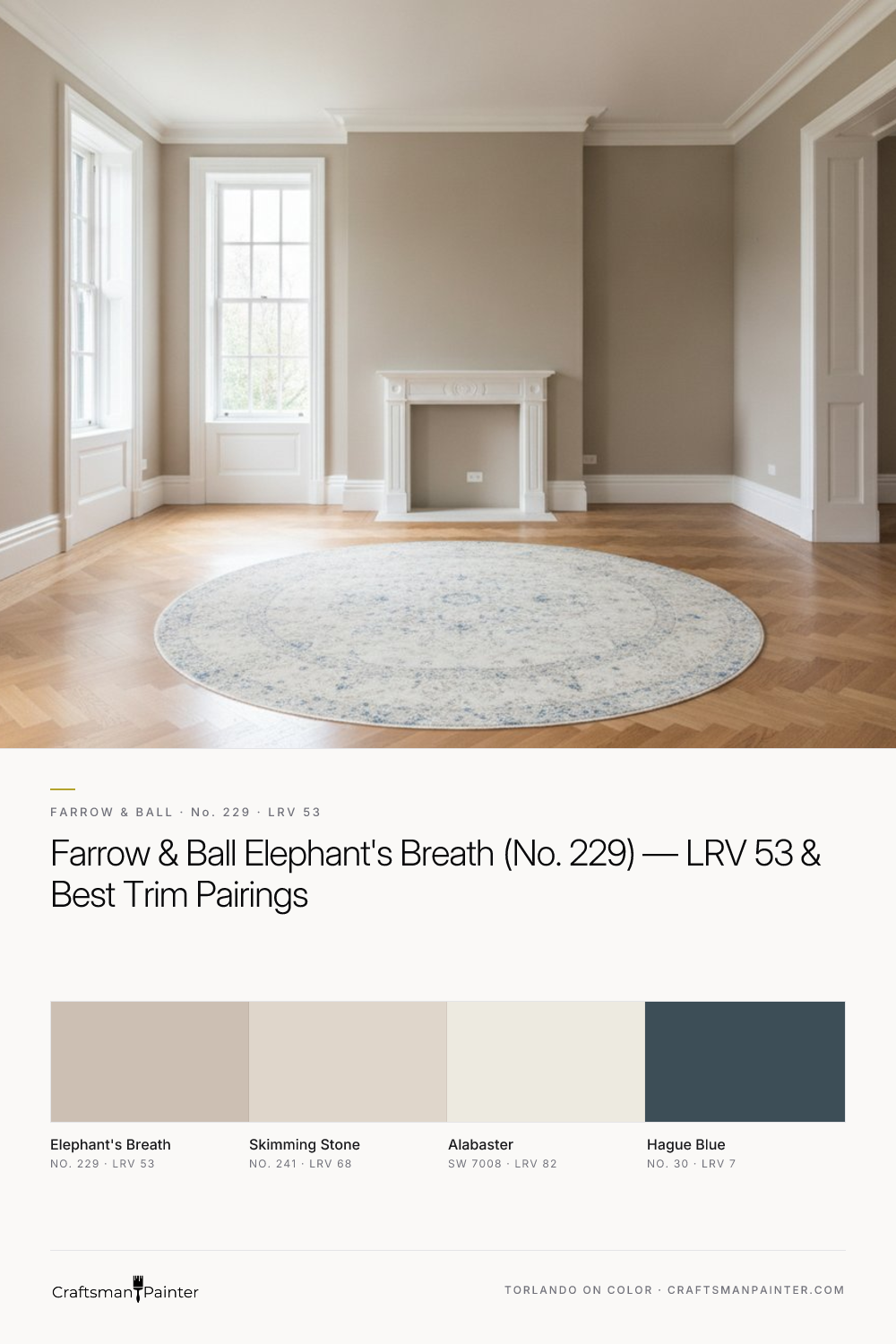


The Subtle Nuance of Elephant's Breath in Living Spaces
Real-paint peel-and-stick samples ship via Samplize. Craftsman Painter may earn a small commission on sample orders at no extra cost to you.
In living rooms and dining areas, Elephant's Breath introduces a quiet elegance. The LRV of 53 provides enough depth to anchor a space, making it feel inviting and refined. In rooms with ample natural light, its warm beige-almond undertones come to the forefront, creating a soft, almost ethereal atmosphere. Conversely, in north-facing rooms or during evening hours, a gentle grey quality can emerge, lending a sophisticated, muted character. When evaluating Elephant's Breath for your walls, it is crucial to avoid the common pitfall of testing swatches directly against an existing painted wall. This approach is misleading due to Josef Albers' principle of simultaneous contrast, where adjacent colors distort our perception of the sample. Instead, isolate real-paint peel-and-stick samples on a clean white background, such as a piece of poster board, and move them around the room at different times of day. For trim and ceilings, Farrow & Ball Skimming Stone (No. 241, LRV 68) offers a slightly lighter, complementary tone that maintains the sophisticated Farrow & Ball aesthetic without creating a stark contrast. For wall coatings, I recommend Sherwin-Williams Cashmere Low Lustre for its smooth finish and rich appearance, or Emerald Interior Matte for enhanced washability. Achieving a truly refined finish begins with proper surface preparation, typically Level 2: Standard (Occupied Home) for drywall, ensuring minor imperfections are addressed before painting.
Elephant's Breath in Private Retreats and Transitional Zones
Bedrooms, hallways, and home offices benefit significantly from the calming presence of Elephant's Breath. In a bedroom, its warm, muted quality fosters a serene environment conducive to relaxation. Paired with crisp white linens and natural wood tones, it creates a sanctuary. For hallways, its mid-tone value helps to visually expand the space while providing a cohesive flow between rooms. The inherent depth prevents it from feeling washed out, even in areas with less direct light. For ceilings or adjacent, less prominent walls where a slightly brighter, yet still soft, neutral is desired, Sherwin-Williams Alabaster (SW 7008, LRV 82) serves as an excellent coordinating neutral. Its creamy off-white character harmonizes with the warmth of Elephant's Breath without competing. For interior trim, including baseboards, doors, and window casings, a Level 3: Premium (Luxury Finish) drywall/wood preparation ensures a flawlessly smooth surface. This meticulous prep, addressing all minor imperfections, is essential for a high-end appearance. For the coating itself, Sherwin-Williams Emerald Urethane Trim Enamel in Satin or Semi-Gloss provides exceptional hardness, durability, and a beautiful, lasting finish that stands up to daily wear and tear.
Navigating Humidity: Kitchens, Baths, and Laundry Rooms
In areas prone to humidity and moisture, such as kitchens, bathrooms, and laundry rooms, the choice of paint formula is as critical as the color itself. While Elephant's Breath maintains its sophisticated character in these spaces, it must be paired with a coating designed for performance. Sherwin-Williams Duration Home, specifically formulated for high-humidity environments, offers excellent mildew resistance and washability without compromising the color's integrity. In a kitchen, Elephant's Breath can serve as a sophisticated backdrop for cabinetry, whether they are light or dark. Its warm undertones prevent the space from feeling cold. For a dramatic focal point or to introduce a deeper dimension, consider Farrow & Ball Hague Blue (No. 30, LRV 7) on an island, lower cabinets, or a powder room vanity. The deep, inky blue creates a striking contrast that elevates the entire scheme. Visualizing how these colors interact can be challenging, but tools like our Color Studio can help you explore combinations digitally before committing to samples.
Distinguishing Elephant's Breath: Rivals and Refinements
Understanding Elephant's Breath often involves comparing it to similar, yet distinct, shades. Its closest relative in the Farrow & Ball family is Skimming Stone (No. 241). While both share a muted, sophisticated quality, Skimming Stone (LRV 68) is noticeably lighter and leans more distinctly into a grey-beige territory, with less of the warm almond undertone present in Elephant's Breath. Skimming Stone often appears cooler and airier, making it a suitable choice for those desiring a brighter overall feel, or as a trim color to Elephant's Breath. Another frequent comparison is Benjamin Moore Pale Oak (OC-20). Pale Oak (LRV 69.89) is also a popular greige, but it typically presents as a lighter, warmer, and slightly creamier shade than Elephant's Breath. Pale Oak often carries a subtle pink or violet undertone in certain lights, which Elephant's Breath generally avoids, instead maintaining its consistent warm beige-almond character with a grey influence. Elephant's Breath, with its LRV of 53, offers a more substantial presence, a deeper anchor for a room, making it less susceptible to appearing washed out in bright light. Choosing between these shades comes down to the specific light conditions of your space and the precise balance of warmth and grey you aim to achieve. If you find yourself navigating these subtle distinctions and seeking clarity for your home, a 1-on-1 Color Consultation can provide the tailored guidance you need to make an informed decision.
Frequently Asked Questions
What are the undertones of Farrow & Ball Elephant's Breath?
Farrow & Ball Elephant's Breath (No. 229) primarily features warm beige-almond undertones. Depending on the light and surrounding colors, it can also reveal subtle grey or taupe characteristics, contributing to its sophisticated, chameleon-like quality.
What is the LRV of Farrow & Ball Elephant's Breath?
The LRV (Light Reflectance Value) of Farrow & Ball Elephant's Breath (No. 229) is 53. This places it in the mid-tone range, offering a balanced depth that feels substantial without being overly dark, and reflects a moderate amount of light.
What trim colors pair well with Farrow & Ball Elephant's Breath?
For trim and ceilings, Farrow & Ball Skimming Stone (No. 241) is an excellent complementary choice, offering a slightly lighter, cohesive Farrow & Ball aesthetic. Alternatively, for a brighter, softer contrast, Sherwin-Williams Alabaster (SW 7008) provides a creamy off-white that harmonizes beautifully with Elephant's Breath.
How does Farrow & Ball Elephant's Breath compare to Skimming Stone or Pale Oak?
Elephant's Breath (LRV 53) is deeper and has a more pronounced warm beige-almond undertone compared to Farrow & Ball Skimming Stone (LRV 68), which is lighter and leans more towards a grey-beige. Compared to Benjamin Moore Pale Oak (LRV 69.89), Elephant's Breath is also deeper and typically lacks the subtle pink or violet undertones sometimes seen in Pale Oak, maintaining a more consistent warm greige character.

Mastering the Magic of White Walls and Daring Trim

Softened Green by Sherwin Williams (SW 6177)
