
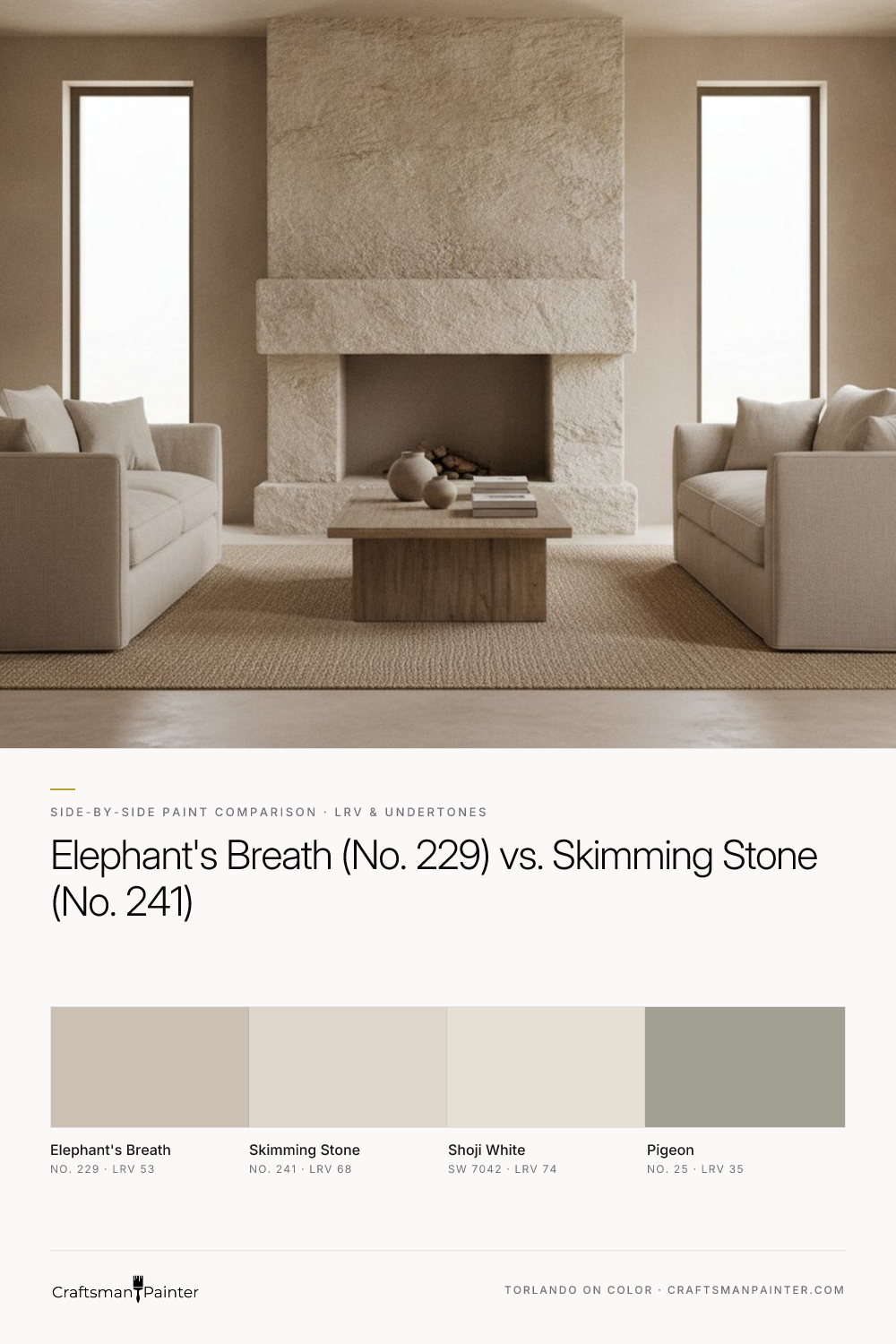


LRV and Perceived Brightness on Full Walls
Real-paint peel-and-stick samples ship via Samplize. Craftsman Painter may earn a small commission on sample orders at no extra cost to you.
Light Reflectance Value (LRV) is a critical metric, indicating the percentage of visible light a color reflects. Elephant's Breath (No. 229) has an LRV of 53, placing it squarely in the mid-tone range. On full walls, this translates to a color with noticeable presence and a grounded feel. It offers a sense of enclosure and coziness, particularly in larger rooms or those with ample natural light where its depth can be appreciated. It will never feel stark or overly bright. Skimming Stone (No. 241), by contrast, boasts an LRV of 68. This significantly higher value means it reflects more light, resulting in a distinctly brighter and airier appearance on full walls. Where Elephant's Breath might create a sophisticated envelopment, Skimming Stone provides a gentle lift, making rooms feel more expansive and open. For comparison, Sherwin-Williams Shoji White (SW 7042), with an LRV of 74, pushes even further into the off-white category, offering maximum brightness with a whisper of warmth. When considering a full room application, gauge whether you desire a more intimate, anchored space (Elephant's Breath) or one that feels subtly bright and expansive (Skimming Stone).
Undertone Differences in North-Facing, South-Facing, and 2700K Evening Light
Undertones are the backbone of how a color truly performs, and light is the conductor. Elephant's Breath (No. 229) carries a warm beige-almond undertone. In a north-facing room, where light is cooler and often carries a blue or gray cast, Elephant's Breath will reveal more of its subtle purple-gray nuances, making it appear as a sophisticated greige with a hint of warmth. It avoids feeling cold, but the beige will be subdued. In a south-facing room, bathed in warmer, more intense light, its true warm beige-almond character emerges, creating a soft, comforting neutral that feels rich and inviting. Under 2700K evening bulbs, which emit a warm, yellowish glow, Elephant's Breath can lean slightly more taupe, with the beige undertone becoming more pronounced, sometimes pulling out a soft, muted plum quality. This is where the color's complexity truly shines.
Skimming Stone (No. 241), while also a warm stone neutral, has a lighter, more ethereal quality. Its warmth is less pronounced than Elephant's Breath. In north-facing rooms, Skimming Stone reads as a very soft, clean greige, often appearing almost off-white with just enough pigment to avoid sterility. The cooler light enhances its gray aspect without making it feel cold. In south-facing rooms, its warmth comes forward as a delicate, creamy off-white, retaining its lightness while feeling inviting. With 2700K evening bulbs, Skimming Stone maintains its soft, creamy greige appearance, perhaps leaning a touch more towards a muted, warm off-white than a distinct beige. It's a more chameleon-like color, adapting subtly without dramatic shifts. For a deeper dive into how specific colors perform, consider utilizing a Color Studio resource to visualize these shifts.
Which Shade Wins Against Warm Oak Floors, White Marble/Quartz, or Cabinetry?
Color selection is always about context, especially concerning fixed elements like flooring, countertops, and cabinetry.
Against warm oak floors, which often carry yellow or orange undertones, Elephant's Breath can be a nuanced choice. If the oak is very rich and dark, Elephant's Breath provides a sophisticated contrast, allowing the floor's warmth to stand out while the wall color offers a grounding, complementary depth. However, if the oak is lighter or has a strong yellow cast, Elephant's Breath might feel too close in warmth, potentially making the room feel heavy or creating an undesirable clash. In such cases, Skimming Stone offers a cleaner, brighter contrast. Its lighter nature allows the oak floors to shine without competing, providing a fresh backdrop that still acknowledges the floor's warmth.
When paired with white marble or quartz countertops, both colors perform well but create different effects. Elephant's Breath provides a beautiful, soft contrast, allowing the crisp white and subtle veining of the marble to pop while introducing a sophisticated warmth to the space. It prevents the room from feeling too stark or cold. Skimming Stone, being lighter, creates a more seamless and ethereal transition. It allows the white marble to remain the focal point, enhancing its pristine quality with a gentle, understated warmth. For a truly minimalist or airy aesthetic, Skimming Stone would be the preferred choice.
For cabinetry, the choice depends on whether the wall color or cabinet color is meant to recede or stand out. If you have classic white cabinetry, Elephant's Breath on the walls creates a refined, slightly moody backdrop, allowing the white cabinets to appear crisp and elegant. If you're considering painting cabinetry, Elephant's Breath can be a stunning choice for island bases or lower cabinets, particularly when paired with a lighter wall color like Skimming Stone or Shoji White. For a more cohesive, understated look, Skimming Stone on walls with white cabinetry provides a soft, harmonious blend. A bolder option for cabinetry, such as Farrow & Ball Pigeon (No. 25, LRV 35), a sophisticated blue-gray, would create a striking contrast with either Elephant's Breath or Skimming Stone on the walls, depending on the desired depth and mood.
Clear Decision Rules for Picking the Winner, Sheen, and Prep Recommendations
Choosing between Elephant's Breath and Skimming Stone comes down to the specific atmosphere you wish to cultivate and how the colors interact with your home's unique lighting and fixed elements.
Choose Elephant's Breath (No. 229) if:
- You desire a warm, enveloping depth that feels sophisticated and grounded.
- Your room receives ample natural light, allowing the color's complexity to unfold without feeling dark.
- You appreciate a color that can shift subtly between beige, almond, and a muted purple-gray depending on the light.
- You want a refined backdrop for white trim (consider Emerald Urethane Trim Enamel in Satin or Semi-Gloss for baseboards and doors) or a complementary shade for deeper, more characterful cabinetry.
Choose Skimming Stone (No. 241) if:
- You prefer a lighter, airier, and more understated neutral that still offers warmth.
- Your room is smaller or receives less natural light, and you want to maximize perceived brightness.
- You seek a versatile color that acts as a soft, harmonious link between various design elements.
- You desire a clean, elegant backdrop that allows other elements, such as white marble or rich wood, to take center stage.
Testing Swatches & Simultaneous Contrast: It is paramount to test colors correctly. Josef Albers' principle of simultaneous contrast dictates that colors appear different when adjacent to other colors. Painting a small swatch directly onto an existing colored wall will mislead you, as the surrounding color influences your perception. Always use large peel-and-stick samples (at least 12x12 inches) and affix them to the wall against a piece of white poster board or existing white trim. Observe them throughout the day and evening, under both natural and artificial light (including your actual 2700K evening bulbs).
Sheen Recommendations: For walls, a low-sheen finish is typically preferred for Farrow & Ball's signature chalky look. Sherwin-Williams Cashmere Low Lustre or Emerald Interior Matte are excellent choices for drywall, providing a rich, velvety appearance. In high-humidity areas like bathrooms and kitchens, Sherwin-Williams Duration Home offers enhanced moisture resistance while maintaining a sophisticated finish. For trim, doors, and cabinetry, Sherwin-Williams Emerald Urethane Trim Enamel in Satin or Semi-Gloss provides exceptional durability and a smooth, elegant finish that complements the wall color.
Preparation Guidance: Achieving a premium finish with these nuanced colors requires meticulous preparation. For occupied homes, aim for Level 2: Standard (Occupied Home) drywall preparation, which includes patching minor imperfections, sanding, and priming. For a luxury finish, especially with Farrow & Ball's distinctive pigments, Level 3: Premium (Luxury Finish) preparation is recommended. This involves a more thorough inspection for imperfections, additional skim coating or filling where necessary, and precise sanding to ensure a perfectly smooth substrate. This level of prep is crucial for the paint to lay flawlessly and for the color's full depth to be realized. If you find yourself needing more tailored advice, a 1-on-1 Color Consultation can provide expert guidance specific to your home's unique conditions.
Ultimately, both Elephant's Breath and Skimming Stone are exquisite choices from Farrow & Ball's collection. Your decision will hinge on the specific visual and emotional impact you wish to create within your living spaces.
Frequently Asked Questions
Is Farrow & Ball Elephant's Breath (No. 229) too dark for a small room?
Elephant's Breath (LRV 53) is a mid-tone color. In a small room, it can create a cozy, enveloping atmosphere, especially if there's sufficient natural light. However, if the room is small and lacks ample light, it might feel heavier or more intimate than desired. For smaller, darker rooms, Skimming Stone (LRV 68) or Sherwin-Williams Shoji White (LRV 74) would offer a brighter, more expansive feel.
How do Elephant's Breath and Skimming Stone differ in a north-facing room?
In a north-facing room, both colors will lean cooler. Elephant's Breath (No. 229) will reveal more of its subtle purple-gray undertones, appearing as a sophisticated greige with a distinct warmth. Skimming Stone (No. 241) will read as a very soft, clean greige, almost an off-white, with its gray aspects enhanced by the cooler light, providing a brighter and more ethereal feel than Elephant's Breath.
What trim color pairs best with Farrow & Ball Skimming Stone (No. 241)?
For a classic, crisp look, a clean white trim like Farrow & Ball All White or Sherwin-Williams Pure White (SW 7005) works well with Skimming Stone. If you prefer a softer, more integrated scheme, a creamy off-white or even Skimming Stone itself in a different sheen can create a harmonious effect. For a subtle contrast, Farrow & Ball Strong White can also be a good option.
Can I use Farrow & Ball Elephant's Breath (No. 229) with warm oak cabinetry?
Yes, Elephant's Breath can pair beautifully with warm oak cabinetry, creating a sophisticated and grounded aesthetic. Its warm beige-almond undertone can complement the oak's warmth. However, it's essential to test samples, as the specific undertones of your oak and the room's lighting will dictate how the two colors interact. In some cases, a lighter neutral like Skimming Stone might provide a cleaner contrast if the oak is particularly yellow or orange.
The Accidental Pink: A Color Story on Finding the Perfect White
The One Moody Paint Color Westfield Designers Are Secretly Hoarding for Mudrooms
