


Unveiling Chantilly Lace's Unblemished Purity
Real-paint peel-and-stick samples ship via Samplize. Craftsman Painter may earn a small commission on sample orders at no extra cost to you.
The defining feature of Benjamin Moore Chantilly Lace (OC-65) is its inherent cleanliness. Unlike many whites that carry discernible yellow, gray, or even slight green undertones, Chantilly Lace presents itself as a remarkably true white. This absence of strong chromatic leanings is precisely why it is so highly sought after. In north-facing rooms, where natural light tends to be cooler and grayer, Chantilly Lace maintains its crispness without appearing sterile. In south-facing rooms, bathed in warm, abundant light, it remains bright and inviting, resisting any tendency to become overly creamy or yellowed. East and west exposures, with their fluctuating morning and afternoon light, allow Chantilly Lace to adapt gracefully, always appearing fresh and refined.
Understanding how a paint color truly behaves in your specific environment is critical. Josef Albers’ principle of simultaneous contrast dictates that the perceived color of a swatch is heavily influenced by the colors surrounding it. This means testing a Chantilly Lace sample directly against an existing painted wall, especially one with a strong color, can be highly misleading. The existing wall color will alter your perception of the Chantilly Lace. To accurately assess Chantilly Lace in your home, I always advise homeowners to use real-paint peel-and-stick samples. These should be placed on a white background, such as a piece of poster board, and then held up against existing white trim or a clean white surface. This isolation allows you to evaluate Chantilly Lace’s true character against a neutral backdrop, giving you an honest representation of how it will perform in your space’s unique lighting conditions throughout the day.
Harmonious Pairings: Elevating Chantilly Lace
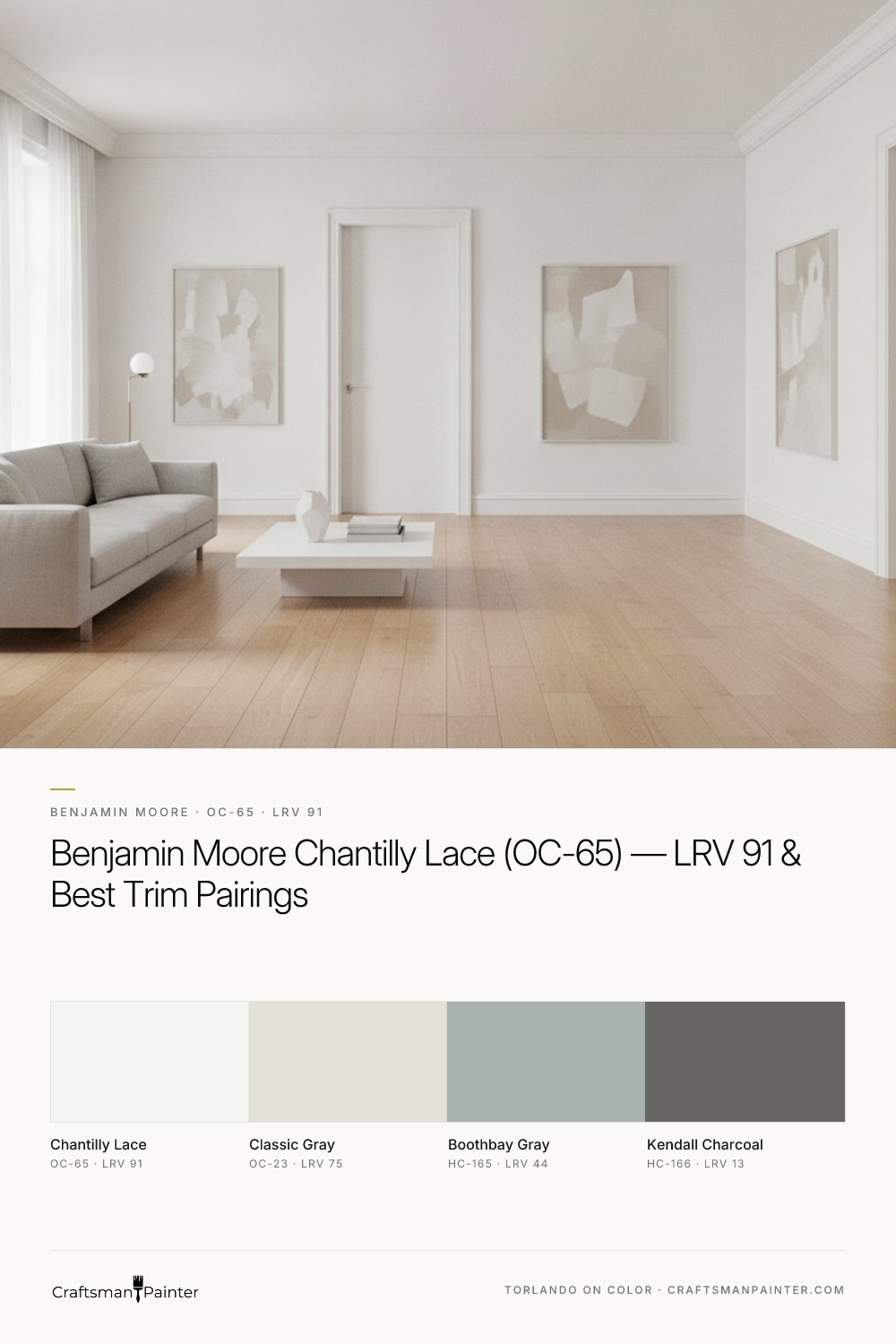
Selecting complementary colors for Chantilly Lace involves understanding its clean nature and leveraging it to enhance other elements in a room. For trim and ceilings, a seamless extension of Chantilly Lace itself often works beautifully, especially when aiming for a monochromatic, expansive feel. However, for a subtle contrast that adds depth without detracting from Chantilly Lace’s purity, Benjamin Moore Classic Gray (OC-23, LRV 75) is an exceptional choice. Classic Gray is a soft, warm gray that provides just enough differentiation to articulate architectural details without introducing competing undertones. It’s a sophisticated partner for trim, doors, and even ceilings, offering a gentle visual separation from the walls.
For coordinating neutrals, Benjamin Moore Boothbay Gray (HC-165, LRV 44) offers a beautiful, muted gray-blue that feels both serene and grounded. This color works well on accent walls, built-ins, or in adjacent rooms, creating a cohesive flow while introducing a touch of cool sophistication. When a stronger contrast is desired, Benjamin Moore Kendall Charcoal (HC-166, LRV 13) serves as an excellent accent. This deep, rich charcoal gray can be used for interior doors, cabinetry, or even exterior elements, providing a dramatic anchor that allows Chantilly Lace to truly pop. The interplay between these shades creates a balanced and visually interesting palette.
When applying these pairings, the choice of coating is as important as the color itself. For interior walls, Sherwin-Williams Cashmere Low Lustre or Emerald Interior Matte provide a beautiful, durable finish. In high-humidity areas like bathrooms and kitchens, Sherwin-Williams Duration Home offers superior moisture resistance. For baseboards, doors, and cabinets, where a harder, more durable surface is needed, Sherwin-Williams Emerald Urethane Trim Enamel in Satin or Semi-Gloss delivers excellent flow, leveling, and a robust finish that stands up to daily wear and tear. This thoughtful selection of coatings ensures both aesthetic appeal and long-term performance.
Chantilly Lace Against Its Closest Rivals
When homeowners are considering Chantilly Lace, two other prominent whites often enter the discussion: Benjamin Moore Simply White (OC-117) and Sherwin-Williams Extra White (SW 7006). While all three are popular whites, their subtle differences are crucial for achieving the desired aesthetic.
Benjamin Moore Simply White (OC-117): This white is known for its slight warmth. While still very bright, Simply White possesses a faint yellow undertone that becomes more apparent when directly compared to Chantilly Lace. It was Benjamin Moore’s Color of the Year in 2016 for good reason; it’s inviting and versatile, particularly in spaces that benefit from a touch of creaminess without being overtly yellow. If your home has fixed elements like cabinetry or flooring with warmer tones, Simply White might harmonize more effectively, offering a softer contrast than Chantilly Lace’s starker purity.
Sherwin-Williams Extra White (SW 7006): This is Sherwin-Williams’ purest white, often used as a base for custom color mixing. Similar to Chantilly Lace, Extra White is extremely clean and lacks strong undertones. However, in a side-by-side comparison, Extra White can sometimes appear slightly cooler than Chantilly Lace, leaning towards a very subtle blue-gray hint, particularly in certain lighting conditions. If you are seeking the absolute brightest, most achromatic white possible, Extra White is a strong contender. However, for many, Chantilly Lace strikes a perfect balance of crispness without feeling cold.
Ultimately, the choice among these three depends on the specific nuances of your home’s existing finishes, natural light, and desired atmosphere. This is precisely why a 1-on-1 Color Consultation can be invaluable; it removes the guesswork and provides tailored recommendations based on your unique circumstances.
Achieving Excellence: Professional Application & Durability
Paint color selection is only half the equation; the quality of preparation and application significantly impacts the final outcome. For a truly premium finish with Benjamin Moore Chantilly Lace, especially on walls, proper surface preparation is paramount. We often recommend Level 2: Standard (Occupied Home) or Level 3: Premium (Luxury Finish) drywall preparation. This involves meticulous sanding, patching, and priming to ensure a smooth, uniform substrate free of imperfections. For wood surfaces like trim and doors, similar attention to detail in sanding and filling ensures a flawless base for the topcoats.
When it comes to coatings, selecting the right product for the right application ensures both aesthetic quality and longevity. For general interior walls, Sherwin-Williams Cashmere Low Lustre or Emerald Interior Matte are excellent choices, offering a sophisticated, low-sheen finish that enhances Chantilly Lace’s purity. For high-traffic areas or spaces prone to moisture, such as kitchens and bathrooms, Sherwin-Williams Duration Home provides enhanced scrubbability and mildew resistance. On baseboards, interior doors, and cabinetry, the smooth, durable finish of Sherwin-Williams Emerald Urethane Trim Enamel in Satin or Semi-Gloss is unmatched. This product offers superior hardness and resistance to chipping, ensuring your crisp Chantilly Lace trim maintains its pristine appearance for years.
Chantilly Lace's enduring appeal lies in its ability to serve as a pristine backdrop for any design style, from contemporary minimalist to classic traditional. It’s a color that provides clarity and brightness without overwhelming a space. For further inspiration and to explore how Chantilly Lace might transform your home, visit our Color Studio. Investing in quality preparation and coatings when using a color as clean as Chantilly Lace ensures that its inherent elegance is fully realized, providing a lasting, beautiful foundation for your home’s interior.
Frequently Asked Questions
What are Benjamin Moore Chantilly Lace's undertones?
Benjamin Moore Chantilly Lace (OC-65) is celebrated for its exceptionally clean and neutral undertones. It possesses a minimal chromatic cast, meaning it avoids strong leanings towards yellow, pink, blue, or gray, making it one of the purest whites available. This characteristic allows it to maintain its crispness in various lighting conditions without appearing warm or cool.
What is the LRV of Benjamin Moore Chantilly Lace, and what does it mean for my space?
Benjamin Moore Chantilly Lace has a Light Reflectance Value (LRV) of 91. LRV is a scale from 0 (absolute black) to 100 (pure white) that indicates how much light a color reflects. An LRV of 91 signifies that Chantilly Lace reflects a significant amount of light, making rooms feel brighter, more open, and expansive. It is an excellent choice for maximizing natural light and creating a fresh, airy atmosphere.
What trim color pairs best with Benjamin Moore Chantilly Lace?
For a seamless and consistent look, using Chantilly Lace itself on trim provides a cohesive, monochromatic effect. However, for a subtle yet sophisticated contrast, Benjamin Moore Classic Gray (OC-23) is an excellent choice. Its soft, warm gray undertones offer gentle differentiation for architectural details without competing with Chantilly Lace's purity. For a durable finish, consider Sherwin-Williams Emerald Urethane Trim Enamel in Satin or Semi-Gloss.
How does Benjamin Moore Chantilly Lace compare to Simply White or Sherwin-Williams Extra White?
Chantilly Lace is known for its clean, pure white appearance. Benjamin Moore Simply White (OC-117) is slightly warmer than Chantilly Lace, carrying a faint yellow undertone that can make it feel a bit softer and more inviting. Sherwin-Williams Extra White (SW 7006) is also a very pure white, often appearing slightly cooler than Chantilly Lace, sometimes with a very subtle blue-gray hint. The best choice depends on your home's fixed elements and the specific warmth or coolness you desire.

Can a High-Reflectance White Feel Soft Instead of Sterile? The Case for Benjamin Moore Frostine AF-5

Warm Gray and Muted Green Converge in the Quiet Depth of Sherwin-Williams Ellsworth (SW 7650)
