
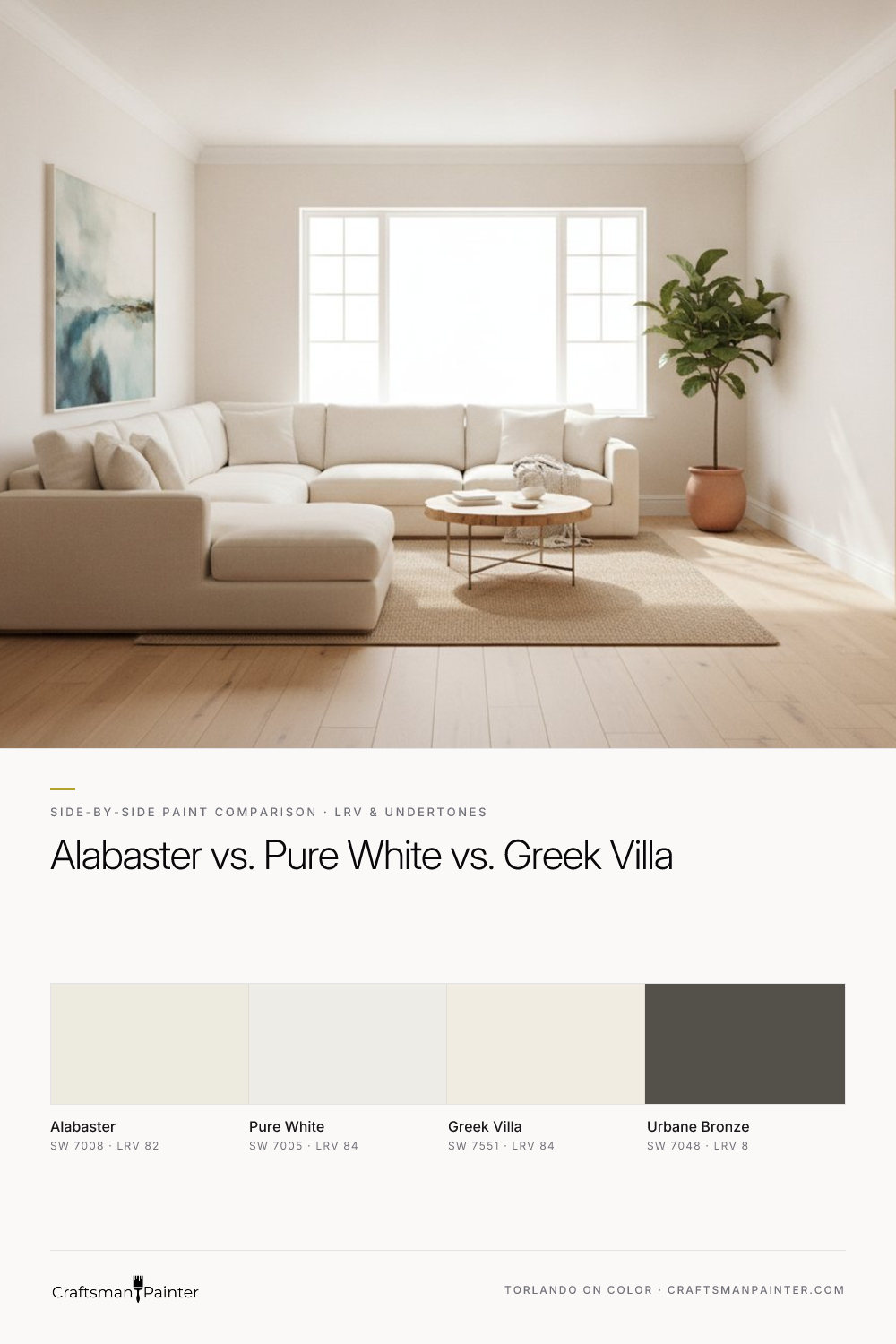


LRV and Perceived Brightness on Full Walls
Real-paint peel-and-stick samples ship via Samplize. Craftsman Painter may earn a small commission on sample orders at no extra cost to you.
Light Reflectance Value (LRV) is a crucial metric, indicating how much light a color reflects. Alabaster (SW 7008) carries an LRV of 82. This positions it as a soft, off-white. It reflects ample light, yet its slightly lower LRV compared to many pure whites grants it a gentle, inviting quality. It avoids starkness, feeling more like a creamy, softened white rather than a stark, reflective surface.
In contrast, Pure White (SW 7005) and Greek Villa (SW 7551) both share an LRV of 84. While a difference of two points on the LRV scale might seem negligible on paper, on a full wall, especially in a well-lit room, it can be perceptible. Pure White lives up to its name, presenting as a very clean, crisp white. Its high LRV ensures maximum light reflection, contributing to a bright, expansive feel. Greek Villa, despite the identical LRV of 84, often reads as having slightly more body than Pure White. This is due to its undertones, which give it a subtle richness that can make it appear a touch less stark, even while reflecting the same amount of light.
On large wall expanses, Alabaster will always appear softer and more muted than Pure White or Greek Villa. Pure White provides the most unadulterated brightness. Greek Villa occupies a space where it is bright but carries a noticeable warmth that prevents it from feeling cold. The choice here depends on whether you seek a soft glow, a clean brightness, or a warm luminosity.
Undertone Differences in Varying Light and 2700K Bulbs
Undertones are the subtle colors that reveal themselves under different lighting conditions. This is where the true character of these whites emerges. To accurately assess, I advise clients to use large, real-paint peel-and-stick samples. Due to Josef Albers' principle of simultaneous contrast, placing a new color directly against an existing painted wall will distort your perception. The existing color influences how you see the new one. Instead, isolate your samples by placing them against a neutral white trim or a clean white poster board to observe their true nature. For a deeper dive into color selection, our Color Studio offers valuable resources.
Alabaster (SW 7008) possesses soft, warm cream-yellow undertones. In a north-facing room, which receives cooler, indirect light, Alabaster's warmth is essential. It prevents the room from feeling cold or sterile, maintaining a creamy, inviting atmosphere. The cool light tempers its yellow notes, making it appear as a sophisticated, soft white. In south-facing rooms, bathed in warm, direct sunlight, Alabaster's creaminess intensifies, glowing with a comfortable, sun-kissed warmth. With 2700K evening bulbs, which emit a warm, yellowish light, Alabaster will lean further into its creamy, almost buttery character, creating a cozy and intimate ambiance.
Pure White (SW 7005) is renowned for its minimal undertones. It is a very clean white, with just enough warmth to prevent it from feeling clinical. In north-facing rooms, Pure White maintains its crispness without tipping into blue or gray. It provides a bright, refreshing backdrop. In south-facing rooms, it will appear exceptionally bright and clear, reflecting the abundant light without adding significant color. Under 2700K evening bulbs, Pure White will warm up, but it retains its clean quality, appearing as a soft, true white rather than veering into yellow or cream. It is a reliable choice when you need a white that stays consistently neutral.
Greek Villa (SW 7551) introduces a slightly more complex warmth than Alabaster. While still warm, its undertones lean towards a creamy off-white with a subtle hint of greige. In north-facing rooms, Greek Villa's warmth is evident, similar to Alabaster, but it can sometimes reveal a very faint greige nuance, grounding the color slightly. In south-facing rooms, it radiates a rich, inviting warmth, appearing more saturated than Alabaster. Under 2700K evening bulbs, Greek Villa's creamy, warm qualities are enhanced, making it feel particularly rich and inviting, often reading as a soft, warm ivory. It is a good choice when you desire a white with noticeable depth and warmth.
Which Shade Wins Against Warm Oak, White Marble/Quartz, or Cabinetry?
The interplay between wall color and fixed elements is critical for a cohesive design.
Warm Oak Floors/Cabinetry: For homes featuring warm oak floors or natural oak cabinetry, Alabaster and Greek Villa are often excellent companions. Alabaster's soft cream-yellow undertones harmonize with the golden and amber tones of oak, creating a seamless, inviting flow. It enhances the wood's natural warmth without competing. Greek Villa, with its slightly richer creamy-greige notes, also works beautifully, providing a slightly more substantial warmth that complements the oak. Pure White, while versatile, will provide a crisper contrast. It can make the oak appear richer and more defined by offering a clean, bright counterpoint, but it will not blend as softly as Alabaster or Greek Villa.
White Marble or Quartz Countertops/Backsplashes: When working with white marble or quartz, particularly those with cooler gray veining or a very clean, bright white base, Pure White is frequently the optimal choice. Its minimal undertones ensure a clean, cohesive look that mirrors the pristine quality of these surfaces. Alabaster and Greek Villa, with their discernible warm undertones, can sometimes clash with cooler-toned white marbles, making the walls appear yellowed or the marble appear dingy. However, if your marble or quartz has warmer, creamier veining, Alabaster or Greek Villa could be a sophisticated choice, tying those warmer tones into the room's palette. It is essential to test samples directly against your specific stone.
Cabinetry: For painted cabinetry, the selection follows similar principles. Pure White offers a timeless, crisp look, especially in modern or transitional kitchens. For a softer, more traditional aesthetic, or to complement natural wood elements, Alabaster or Greek Villa can provide a gentler backdrop. Consider using Sherwin-Williams Emerald Urethane Trim Enamel in Satin or Semi-Gloss for exceptional durability and a smooth finish on cabinets and trim. For a bold accent, consider Sherwin-Williams Urbane Bronze (SW 7048, LRV 8) on an island or a pantry door, which provides a grounding depth against any of these whites.
Clear Decision Rules and Sheen/Prep Recommendations
Making the final decision requires a careful assessment of your desired outcome and existing elements:
-
Choose Alabaster (SW 7008) if you desire a soft, enveloping warmth that feels inviting and avoids any hint of starkness. It is ideal for traditional or farmhouse styles, spaces with natural wood elements, or north-facing rooms that need warmth. It provides a gentle glow.
-
Choose Pure White (SW 7005) if you seek a consistently clean, crisp, and bright white that serves as a neutral backdrop for other colors or art. It is highly versatile, suited for modern, transitional, or minimalist aesthetics, and pairs well with cooler-toned materials or when a truly unadulterated white is needed.
-
Choose Greek Villa (SW 7551) if you want a white with a bit more body and a richer, creamy warmth than Alabaster, but still bright. It works well in spaces that benefit from a noticeable warm glow without appearing overtly yellow. It can be a good choice for connecting varied warm and cool elements.
Sheen Recommendations:
For walls in general living areas, Sherwin-Williams Cashmere Low Lustre or Emerald Interior Matte provide a beautiful, sophisticated finish that minimizes imperfections. For high-traffic areas, kitchens, or bathrooms where humidity and cleaning are concerns, Sherwin-Williams Duration Home in a Matte or Satin finish offers superior scrubbability and durability. For all trim, doors, and cabinetry, Emerald Urethane Trim Enamel in Satin or Semi-Gloss is my recommendation for its exceptional hardness, flow, and leveling properties, resulting in a smooth, furniture-like finish.
Preparation Guidance:
Proper surface preparation is paramount for any luxury finish. For typical occupied homes, I recommend Level 2: Standard (Occupied Home) preparation, which includes thorough cleaning, sanding existing surfaces to de-gloss and smooth, and spot priming any repairs or bare areas. For new construction or when aiming for a truly flawless, high-end look, particularly for smooth walls, Level 3: Premium (Luxury Finish) preparation is necessary. This involves extensive skim coating, fine sanding, and full priming to achieve a perfectly uniform and smooth substrate before applying the finish coats. Neglecting proper prep will compromise the final appearance, regardless of the paint quality.
If you are still navigating the complexities of white selection or need a tailored palette for your entire home, a personalized 1-on-1 Color Consultation can provide the clarity and confidence you need to make the right choice for your space.
Frequently Asked Questions
What is the primary difference in warmth between Sherwin-Williams Alabaster, Pure White, and Greek Villa?
Alabaster (SW 7008) is a soft, creamy off-white with noticeable warm, yellow undertones. Pure White (SW 7005) is a very clean, neutral white with minimal warmth, making it versatile and crisp. Greek Villa (SW 7551) offers a slightly richer, more saturated creamy warmth than Alabaster, often with a subtle greige nuance, providing more body than a pure white.
Which of these whites is best for a north-facing room that tends to feel cold?
For north-facing rooms, which receive cooler, indirect light, both Alabaster (SW 7008) and Greek Villa (SW 7551) are excellent choices. Their inherent warm, creamy undertones counteract the cool natural light, preventing the room from feeling stark or sterile and creating a more inviting atmosphere. Alabaster offers a softer warmth, while Greek Villa provides a slightly richer, more substantial warmth.
Can I use Alabaster, Pure White, or Greek Villa with white marble or quartz countertops?
Yes, but with consideration. Pure White (SW 7005) is generally the safest choice for pairing with cooler-toned white marble or quartz, as its minimal undertones ensure a clean, cohesive look. Alabaster (SW 7008) and Greek Villa (SW 7551), with their warmer undertones, can work beautifully if your marble or quartz has warmer, creamy veining, helping to tie those tones into the room. Always test large samples directly against your specific stone to ensure harmony.
What sheen should I choose for walls and trim when using these Sherwin-Williams whites?
For general walls, Sherwin-Williams Cashmere Low Lustre or Emerald Interior Matte provides a sophisticated finish. In high-traffic areas, kitchens, or bathrooms, Duration Home (Matte or Satin) offers enhanced durability. For all trim, doors, and cabinetry, Emerald Urethane Trim Enamel in Satin or Semi-Gloss is recommended for its hard, smooth finish and excellent durability.

Sherwin-Williams Whitetail: A Warm White Paint for Inviting Interiors
The Accidental Pink: A Color Story on Finding the Perfect White
